E-commerce is one of India’s fastest-growing retail channels. Its success depends on speed: same-day delivery, next-day delivery, and dependable stock. Every fast delivery is supported by an efficient fulfilment center equipped with the right material handling equipment Material Handling Equipment for E-commerce.
The E-commerce Challenge – Why MHE Matters
Choosing the wrong MHE can lead to delays, dissatisfied customers, and lost revenue. If you get it right, you’ll be sending out hundreds of orders a day with high speed and accuracy.
E-commerce fulfillment is a tough challenge:
- Order volume: 100-10,000 orders/day (peaks can be 50k or more)
- SKU variety: 1,000–100,000+ unique products
- Order complexity: Some orders contain only one item, some contain 10 or more items
- Delivery promise: Even small delays can impact delivery commitments (same day/next day)
- Cost margin: Profit margins per order are often thin, making operational efficiency critical.
Without proper MHE:
- Processing of orders takes 4-6 hours
- Picking errors run 3-5%
- Labour costs keep rising
- On-time delivery suffers
With optimized MHE:
- Fulfilment times can be significantly reduced, often to under a few hours.
- Picking accuracy reaches 99.5%+
- Labour productivity can improve substantially
- On-time delivery consistently >95%
E-commerce Fulfillment Process – MHE at Each Stage
Stage 1: Receiving & Inbound
Products are delivered in bulk from suppliers.
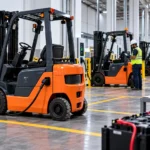
- Forklifts are used to unload inbound shipments efficiently.
- Conveyor transports products to quality control station
- Barcode scanning is used to verify quantities and support quality checks.
MHE required:
- Forklifts (3-5T) – 2
- Receiving conveyors – 2
Stage 2: Putaway to Storage
Goods are moved into the warehouse for storage.
- Products are scanned and assigned to storage locations through the warehouse management system (WMS).
- Goods are transported to storage racks using either electric pallet jacks or forklifts
- The WMS tracks the location of each item in real time.
- Fast put away – within 2-4 hours of receipt
MHE needed:
- Electric pallet jacks
- Shelving/racking
- Mobile scanner terminals
Stage 3: Order Picking – This is the bottleneck. Most time is spent here.
Traditional (slow):
- Operator gets picking list (paper or handheld)
- Scans, finds items, walks aisles
- Collects items for single order
- Manual picking can be time-consuming, especially in large facilities with extensive SKU ranges.
Optimized (fast):
- The system batches multiple orders together (10-20 orders that can be combined)
- The optimal picking route has been calculated
- In goods-to-person systems, products are brought to the picker, reducing travel time and improving efficiency.
MHE required:
- Conveyor systems
- Carousel/Vertical storage
- RF terminals
- Sortation systems
Stage 4: Sort & Consolidate
Products from different orders which are grouped by destination.
- Automated sortation systems direct items to the appropriate lanes based on destination or order requirements.
- Items that are consolidated with other orders in the same direction
MHE needed:
- Conveyor sorters
- Diverters
- Consolidation conveyors
Stage 5: Packing
- Items placed in boxes/mailers
- Weight checked (scale check)
- Labels applied (thermal printer)
- Barcode scanned confirmation
MHE needed:
- Packing tables
- Scales
- Label printers
- Tape dispensers
Stage 6: Shipping & Dispatch
- Packed boxes are sorted by courier partner and delivery destination
- Ready in dispatch trucks
- Pick-up by last mile partners for delivery
MHE equipment required: Loading docks, sorting conveyors and shipping conveyors.
Key MHE Equipment for E-commerce Centres
Disclaimer: Costs are indicative and may vary based on system specifications, facility size, and operational requirements.
| Equipment | Cost (Monthly Rental) | Purpose | Impact |
| Receiving conveyor | ₹20,000-30,000 | Quick truck offloading | 80% faster receiving |
| Electric pallet jacks | ₹10,000-15,000 each | Move goods in warehouse | Reduces labour fatigue |
| Gravity flow racks | ₹50,000/section | FIFO automated putaway | Faster picking |
| Conveyor sorters | ₹5,00,000+ | Automated order sorting | 99%+ accuracy |
| Vertical carousel | ₹2,00,000+/month | Compact storage | Space savings 60% |
| Automated tape dispenser | ₹5,000/month | Package sealing | Labour reduction |
| RF terminals | ₹3,000/unit/month | Wireless barcode scanning | Real-time updates |
| Sortation system | ₹1,00,000-5,00,000 | Sort by courier/destination | Faster dispatch |
How MHE Improves E-commerce Efficiency
Picking Time: Manual 30-40 min → Batching 15-20 min → Conveyor picking 5-10 min
Accuracy: Accuracy often improves significantly when barcode scanning, WMS integration, and automated sortation systems are implemented.
Labour: Automation can reduce labour dependency while increasing throughput.
Cost: ₹40-50 per order → ₹15-20 per order → ₹8-10 with full automation
Financial impact: Even modest reductions in fulfilment costs can generate substantial annual savings at high order volumes.
Reducing Delivery Time Using MHE
- Fast putaway: Orders are processed within 4 hours of receipt (traditionally 24 hours)
- Batching picking: 10+ orders picked at the same time and not in sequence
- Automated sortation: No manual sortation delays by destination
- Dock Scheduling: Pre-arranged with couriers (pick-up within 2 hours of packing)
Result: In a well-optimised fulfilment network, orders can move from placement to dispatch within the same day, supporting faster delivery commitments.
Common E-commerce Challenges & MHE Solutions
Challenge 1 – Peak Season Overload (Diwali, year-end) Solution: Rent additional MHE for e-commerce for 2-4 months. Cost: Renting additional equipment during seasonal peaks can be significantly more cost-effective than purchasing equipment for short-term demand spikes.
Challenge 2: SKU Explosion (more than 1,000 products) Solution: Vertical Carousels/AS/RS – Compact storage, faster retrieval. Time savings: 30-40% faster picking.
Challenge 3: Promise of Same Day Delivery Solution: Distributed fulfillment centers and faster Material Handling Equipment for E-commerce (smaller and closer to customers). Delivery window: 24 hours/next morning.
Challenge 4: Return Processing Solution: Conveyor with a separate return area, with a barcode scanner. A structured returns process can help recover a significant proportion of returned inventory, depending on product type and condition.
Cost of Setting Up an E-commerce Fulfillment Center
Small center (1,000-5,000 orders/day):
- Space: 5,000-10,000 sq ft
- MHE: ₹20-50 lakhs (Forklifts, Racks, Scales, Printers)
- WMS: ₹5-15 lakhs (software)
- Labour: ₹20-40 employees
- Total setup: ₹50-100 lakhs
- Monthly OpEx: ₹20-30 lakhs
Costs are indicative and vary based on automation levels, location, throughput requirements, and technology investments.
Large center (10,000-50,000 orders/day):
- Space: 50,000-200,000 sq ft
- MHE for e-commerce: ₹5 crores to ₹20 crores (Conveyors, Sorters, Carousel systems, Automation)
- WMS: ₹50-200 lakhs (enterprise-level)
- Labour: 200-500 employees
- Total setup: ₹10-50 crores
- Monthly OpEx: ₹2-5 crores
Buy vs rent: Many e-commerce businesses choose rental models for flexibility and lower upfront capital requirements.
Key Takeaway
The speed and accuracy of your fulfillment process are key factors in achieving e-commerce success. The right material handling equipment plays a critical role in improving fulfilment speed, accuracy, and operational efficiency. Today’s e-commerce distribution facilities are no longer just about manual warehouse operations, but about streamlined processes and equipment.
Looking to develop or expand an e-commerce fulfillment center? Mazda Movers offers an end-to-end seamless MHE solution for e-commerce with:
- Rental flexibility
- Maintenance support
- Expertise to help optimise fulfilment speed, operational efficiency, and warehouse productivity.
Connect now and let us take care of material handling operation requirements for your e-commerce business.
Also, follow us on Instagram, Facebook and LinkedIn for insights on fleet modernization, automation trends, and advanced logistics strategies.