Quick Answer
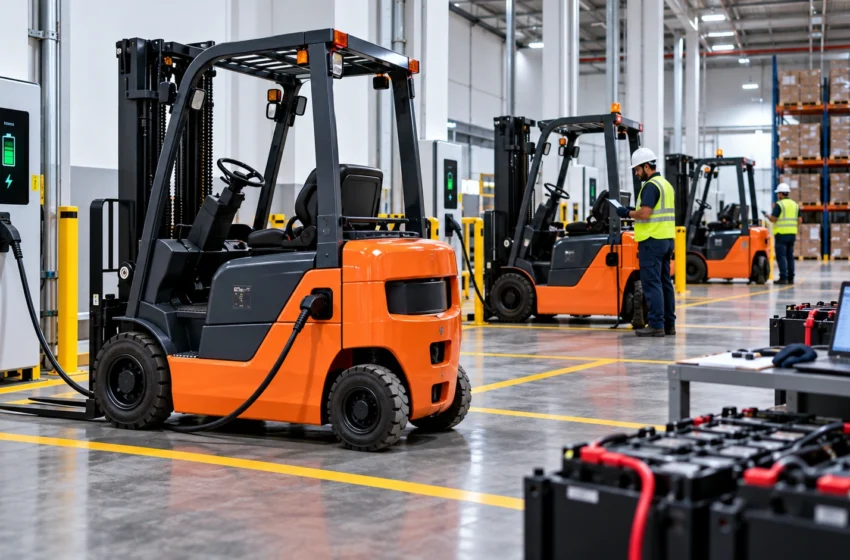
Effective forklift battery charging in a multi-shift warehouse requires more than plugging a battery into a charger when it runs low. Businesses should establish a planned charging process covering charging schedules, designated charging areas, battery condition, charger compatibility, operator practices and maintenance.
The objective is to keep electric forklifts available across shifts without creating unnecessary charging delays or avoidable battery issues. Charging practices should always follow the forklift and battery manufacturer’s instructions, particularly for battery type, charger compatibility, charging method and safety requirements.
Key Takeaways
- Plan charging around shift patterns and actual forklift utilisation.
- Use chargers compatible with the specific forklift battery system.
- Keep charging areas designated, accessible and appropriately managed.
- Include batteries and charging systems in regular maintenance checks.
- Consider electric forklift rental when additional equipment is needed during peak periods or while fleet requirements are being assessed.
Why Is Battery Charging Important in Multi-Shift Warehouses?
Electric forklifts can support material movement across warehouses, distribution centres, manufacturing facilities and large retail operations. In a single-shift operation, charging can often be scheduled around working hours. Multi-shift operations are more demanding because equipment may need to remain available for extended periods.
Poor charging planning can result in:
- Forklifts waiting for charged batteries
- Operators searching for available equipment
- Unplanned equipment downtime
- Disruption between shifts
- Incorrect charging practices
- Increased pressure on available forklifts
A structured forklift battery charging process helps connect equipment availability with the warehouse’s operating schedule.
How Should Warehouses Plan Battery Charging?
Should charging be based only on battery level?
Not necessarily. Charging should be planned according to the battery type, manufacturer’s instructions, operating schedule and actual equipment utilisation.
A warehouse should understand when forklifts are likely to be available for charging rather than allowing charging to become an unplanned activity during busy periods.
How should charging be coordinated across shifts?
Start by mapping forklift usage across each shift.
Identify:
- Number of forklifts in operation
- Typical operating hours
- Shift change timings
- Charging windows
- Available chargers
- Battery requirements
- Periods of highest equipment demand
This helps determine whether the existing charging arrangement can support the operating schedule.
What Challenges Can Affect Forklift Battery Charging?
Charging bottlenecks
If multiple forklifts require charging at the same time but charger availability is limited, equipment may remain unavailable.
The warehouse should compare charging demand with the number and type of charging points available.
Incorrect charger or battery pairing
A charger should be compatible with the battery system it is intended to charge. Using an unsuitable charging setup can create equipment and battery-related issues.
Unplanned downtime
When charging is treated as an afterthought, forklifts may become unavailable at critical points during a shift.
Charging schedules should therefore be integrated into the wider fleet plan.
MHE Selection Table
| Warehouse Requirement | Equipment Consideration | Operational Focus |
|---|---|---|
| Single-shift indoor operation | Electric forklift | Planned charging during available periods |
| Multi-shift warehouse | Electric forklift with suitable charging arrangement | Charging coordination between shifts |
| High forklift utilisation | Electric forklift and appropriate battery/charging setup | Minimise avoidable charging downtime |
| Temporary increase in demand | Electric forklift rental | Additional handling capacity |
| Forklift undergoing maintenance | Rental replacement equipment | Maintain material flow |
| Multiple forklift types | Compatible charging infrastructure | Correct charger and battery matching |
The exact charging requirements depend on the forklift, battery and charger configuration.
How Can Warehouses Improve Charging Practices?
Step 1: Identify the battery type — Understand the battery technology used in each forklift and follow the manufacturer’s charging requirements.
Step 2: Map shift utilisation — Record when each forklift operates and when it is available for charging.
Step 3: Establish designated charging areas — Charging should take place in an appropriately designated area that supports the equipment and battery requirements.
Step 4: Match chargers correctly — Confirm charger compatibility before use and avoid informal charging arrangements.
Step 5: Create shift-level procedures — Operators should know when and how equipment is expected to be charged, including any required pre- and post-charging checks.
Step 6: Monitor recurring issues — Track charging interruptions, battery-related problems and equipment downtime to identify recurring operational issues.
Step 7: Include charging in maintenance planning — Battery condition, charger performance and associated forklift systems should form part of the maintenance programme.
What Safety Practices Should Operators Follow?
Battery charging areas should be managed according to the battery manufacturer’s requirements, equipment instructions and applicable workplace safety procedures.
Depending on the battery technology, requirements can differ. Businesses should therefore avoid applying the same charging procedure to every electric forklift.
Operators should also:
- Use the designated charging equipment
- Inspect equipment according to established procedures
- Follow manufacturer charging instructions
- Keep charging areas properly managed
- Report damaged batteries, cables, connectors or chargers
- Avoid using visibly damaged charging equipment
- Follow site-specific emergency procedures
For lead-acid batteries in particular, battery maintenance and charging requirements should be followed carefully according to the manufacturer’s guidance.
How Do Maintenance Services Support Battery Performance?
Battery charging is closely connected to equipment maintenance.
Forklift maintenance services can help businesses monitor the wider condition of electric forklifts and identify issues involving charging systems, batteries and other equipment components.
A maintenance programme can include appropriate inspections, servicing and documentation based on the manufacturer’s requirements and the operating environment.
The exact maintenance schedule should be established for the specific forklift and battery configuration rather than applying one schedule to every machine.
When Can Electric Forklift Rental Help?
Businesses may not always need to purchase additional electric forklifts to handle temporary demand.
Electric forklift rental can be considered when:
- Warehouse volumes increase temporarily
- A new facility is being tested
- Existing forklifts are undergoing maintenance
- Seasonal demand requires additional equipment
- A business wants additional handling capacity for a project
- Fleet requirements are still being evaluated
Rental can also help businesses assess whether an electric forklift and its charging requirements suit a particular operating environment before making a longer-term equipment decision.
Cost Considerations
Battery charging affects more than electricity consumption.
Businesses should consider:
- Electricity usage
- Charger requirements
- Battery replacement considerations
- Maintenance
- Equipment downtime
- Charging-related waiting time
- Forklift utilisation
- Operator availability
- Number of charging points
- Additional rental requirements
A charging system that does not match the operating schedule can create hidden costs through equipment waiting and reduced availability.
Similarly, adding more forklifts without reviewing the charging arrangement may simply shift the bottleneck from material handling to charging.
India-Specific Considerations
Indian warehouses, manufacturing plants, automotive facilities and large retail distribution operations can operate across extended shifts, making equipment availability particularly important.
Charging arrangements should account for the site’s electrical infrastructure, operating schedule, available charging area and environmental conditions.
For businesses expanding electric forklift use, it is useful to evaluate the forklift and charging infrastructure as one system rather than treating the charger as a separate purchase.
Common Mistakes Businesses Should Avoid
- Charging batteries without following manufacturer instructions
- Using incompatible chargers
- Waiting until batteries are depleted before planning charging
- Allowing multiple shifts to compete for limited charging capacity
- Ignoring battery or charger maintenance
- Failing to designate an appropriate charging area
- Applying the same procedure to different battery technologies
- Ignoring recurring charging-related downtime
- Not training operators on site procedures
- Increasing the electric forklift fleet without reviewing charging capacity
Industry Insight
At Mazda Movers, we look at electric forklift requirements as part of the complete material-handling operation.
For a multi-shift warehouse, the forklift itself is only one part of the planning. Battery availability, charging arrangements, utilisation and maintenance all influence whether the equipment remains available when the operation needs it.
A good charging plan should therefore be built around the actual shift pattern and equipment usage. It should also leave room for maintenance and unexpected operational requirements rather than assuming every forklift will follow the same daily pattern.
How to Choose an MHE Partner
When evaluating an electric forklift or MHE partner, businesses should check:
- Understanding of electric forklift applications
- Availability of suitable rental equipment
- Battery and charger compatibility support
- Maintenance capabilities
- Preventive maintenance options
- Breakdown support
- Equipment availability
- Charging-related guidance
- Flexibility for changing fleet requirements
- Clear rental and service terms
A suitable partner should be able to discuss the forklift, battery, charging and maintenance requirements together.
Why Mazda Movers?
Mazda Movers provides material-handling solutions including electric forklift rental, forklift rental services and forklift maintenance services.
For businesses operating electric forklifts across demanding warehouse schedules, these services can support temporary capacity requirements, equipment replacement and ongoing maintenance needs.
Key Takeaway
Good forklift battery charging practices start with understanding the equipment, battery, charger and operating schedule. In a multi-shift warehouse, charging should be planned as part of fleet management rather than treated as an isolated task.
If your warehouse is expanding its electric forklift fleet or experiencing charging and equipment availability challenges, reviewing the application and maintenance requirements with an experienced MHE provider can help identify suitable support options.
FAQs
Q1. How often should an electric forklift battery be charged?
A. Charging frequency depends on the battery type, forklift usage and manufacturer’s instructions. Businesses should plan charging around actual utilisation rather than applying one schedule to every forklift.
Q2. Can electric forklifts be used across multiple shifts?
A. Yes, but multi-shift operations require appropriate battery, charging and fleet planning to maintain equipment availability.
Q3. Can I use any charger for an electric forklift?
A. No. The charger must be compatible with the specific battery and forklift system. Always follow the manufacturer’s requirements.
Q4. How can forklift battery charging downtime be reduced?
A. Map forklift utilisation, coordinate charging between shifts, ensure adequate compatible charging infrastructure and monitor recurring charging-related downtime.
Q5. Can electric forklifts be rented?
A. Yes. Electric forklift rental can be considered for temporary demand, equipment replacement, seasonal requirements or businesses evaluating electric material-handling equipment.