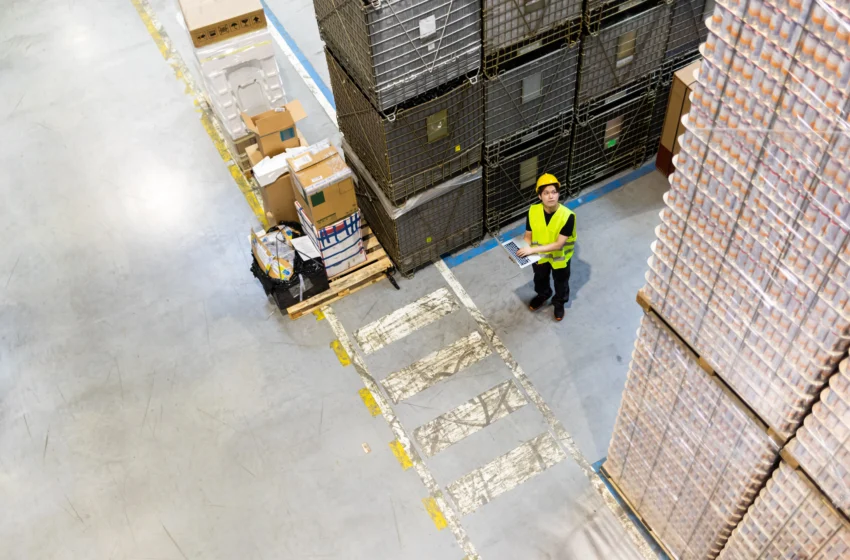
The warehouse looks fine on the floor.
Inventory is in racks. Operators are working. Forklifts are moving. The monthly P&L shows the warehouse cost line slightly above budget but not enough to trigger an inquiry. And yet the operation is leaking eight to fifteen percent of its operating cost into places nobody is measuring. The leakage is not theft. It is not pilferage. It is the layout, working against the equipment, every shift.
This is the cost most Indian warehouse operations carry without knowing they carry it. The fix is not a bigger building. The fix is an MHE strategy aligned to the layout the operation actually has.
The Layout Cost Nobody Calculates
The standard warehouse P&L tracks rent, labour, equipment lease, electricity, and damage as separate lines. Each line looks normal. The sum looks normal. What the P&L does not track is the gap between what the labour and equipment could do in a well-laid-out warehouse and what they actually deliver in the layout they are stuck with.
That gap is the hidden cost of layout. It sits inside the labour line, the equipment line, the damage line, and the electricity line. It does not appear as its own number anywhere. Which is why it persists year after year.
What “Poor Layout” Actually Means in MHE Terms
A poor warehouse layout is not necessarily a chaotic warehouse. It can look perfectly organised. What makes a layout poor in MHE terms is one or more of these:
- Aisle widths mismatched to the equipment fleet
- Picking zones placed far from the staging area for the highest-velocity SKUs
- Charging bays located inside the operational path of forklifts
- Cross-traffic between putaway routes and pick paths
- Storage density optimised at the expense of equipment manoeuvre room
Each of these is a layout decision that locks in a recurring operational cost. The equipment compensates for the layout every shift, and the compensation costs money.
The Five Hidden Costs Layout Creates
These five surface in every layout audit we run.
Hidden Cost 1: Extra Travel Time per Pick
The picking operator at a well-laid-out warehouse walks or rides between four and seven metres per pick on average. The same operator at a poorly-laid-out warehouse walks or rides between nine and fifteen metres per pick. The difference is two to four extra seconds per pick.
At three thousand picks per shift across a fleet, that is one and a half to three hours of extra travel time per shift. At Indian warehouse labour rates, that is twelve to twenty-four lakh rupees per year of avoidable cost on labour alone.
Hidden Cost 2: Equipment Wear from Wrong Aisle Width
A counterbalance forklift forced to work in an aisle narrower than its design spec compensates with sharper turns, more reverse manoeuvres, and higher hydraulic stress. Tyres wear faster. Mast bearings wear faster. Hydraulic seals fail earlier. The maintenance cycle compresses.
The same fleet in correctly-sized aisles runs at the equipment manufacturer’s expected service interval. The difference is twenty to forty percent of maintenance cost over the equipment life.
Hidden Cost 3: Damage from Forced Manoeuvres
When the layout forces the equipment into manoeuvres it was not designed for, things hit things. Pallet damage, rack damage, product damage, equipment damage. Each event is small. The sum over a year is significant.
A typical Indian warehouse with a layout-equipment mismatch carries damage costs at one to three percent of inventory value annually. The same warehouse with a properly aligned layout and fleet carries damage at zero-point-three to zero-point-eight percent.

Hidden Cost 4: Charging Downtime in Wrong Location
If the charging bay sits at the wrong end of the warehouse, every battery swap and every plug-in becomes a long ride. Across an electric fleet of twelve forklifts running two shifts, the lost productive time can run thirty to sixty hours per week.
That is two to three full-time equivalent forklift-operator hours that produce no work, every week. At the lease cost of the equipment and the labour cost of the operator, that is real money.
Hidden Cost 5: Labour Cost of Workaround Routes
When the layout has cross-traffic conflicts, the operators develop workaround routes. The workaround route is always longer. The labour cost of the workaround is small per trip and large in aggregate.
The shift supervisor often does not see the workaround because it has been the route since the operators started. The new operator inherits the route. The cost is baked in.
The MHE-First Layout Strategy
A serious MHE-first strategy reorders the warehouse design conversation. Instead of:
- Civil designs the building
- Racking decides the storage density
- MHE is procured to fit what is left
The MHE-first sequence is:
- Throughput model establishes peak hourly equipment needs at year 1, 3, 5
- MHE specification determines aisle width, charging bay siting, and dock geometry
- Racking design optimises storage density within MHE-friendly aisle constraints
- Civil delivers a building that supports both
The MHE-first approach typically increases storage area by two to four percent less than a racking-first approach. It typically increases throughput by twelve to twenty percent and reduces operating cost by six to ten percent. The trade is almost always worth it.
The Three Layout Templates That Work for Indian Warehouses
Three layout templates work consistently for Indian operations across most product categories:
- U-shape layout — receiving and shipping share one side of the warehouse, with storage in a U around them. Best for operations where the same SKUs are received and shipped at different points in the cycle.
- Through-flow layout — receiving on one end, shipping on the other, with storage in between organised by velocity (high-velocity nearest the shipping end). Best for high-volume distribution operations.
- Modular zone layout — discrete zones for high-velocity, medium-velocity, low-velocity, and value-added services, each with its own MHE allocation. Best for 3PLs serving multiple clients with different profiles.
The right template depends on the operation. The wrong template can be made to work, but always at a hidden cost.
When to Redesign Versus Re-Equip
A warehouse with a layout cost problem has two intervention options. The choice depends on the lease term and the depth of the layout issue.
| Situation | Choose |
| Lease has 3+ years remaining and layout has 3+ of the five hidden costs | Redesign layout + re-equip |
| Lease has 1-3 years and layout has 1-2 hidden costs | Re-equip to fit current layout |
| Lease ending in under 12 months | Pre-design the next warehouse properly; live with the current one |
| Operation will expand significantly within 18 months | Redesign as part of expansion plan |
A warehouse that is about to move is not a candidate for redesign. A warehouse that is staying put with three or more layout problems is. The math almost always works in favour of redesign in that case.
The Layout Audit Checklist
Five things to walk and measure on the warehouse floor:
- Average pick travel distance, sampled across ten picks at peak hour
- Aisle width minus equipment manoeuvre clearance in the three most-used aisles
- Charging bay distance from average operating point, walked in real time
- Cross-traffic events per hour at peak, counted by observation
- Damage rate per thousand pallets handled, pulled from the last 90 days of records
Any one of these scoring outside the normal range is a layout issue. Two or more is the threshold for an MHE strategy review.
Final Thoughts
Warehouse layout costs are real, recurring, and almost always uncounted. The operation carries them silently year after year because they sit inside other P&L lines instead of having their own. The fix is an MHE strategy designed for the layout, or where the lease allows, a layout redesign that lets the MHE do what it was built to do.
The eight to fifteen percent of operating cost that the layout costs the typical Indian warehouse is not an industry constant. It is an industry default that the operations who measure it have escaped.
For Indian warehouse operations who suspect their layout is silently costing them throughput, the Vile Parle desk runs a layout-and-MHE audit as a structured engagement.
Request a warehouse layout and MHE audit from Mazda Movers — Vile Parle East, Mumbai.
→ Talk to the Mazda Movers Material Handling Team
Also, follow us on Instagram, Facebook and LinkedIn for insights on fleet modernization, automation trends, and advanced logistics strategies.