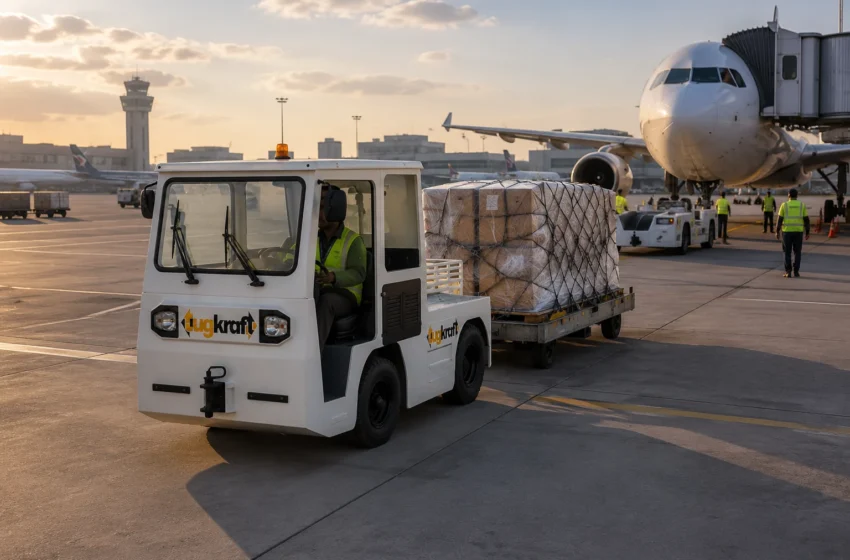
Once an aircraft lands, multiple ground handling vehicles and service teams begin preparing it for the next departure. Depending on the aircraft type and airline operations, turnaround times can range from approximately 30 minutes for some narrow-body aircraft to several hours for larger aircraft.
This swift turnover is achievable only due to Ground Handling Equipment service, which is a set of specialized equipment and operations essential for modern air travel.
What is Ground Handling Equipment (GHE)?
Ground Handling Equipment (GHE) refers to specialised equipment used on the airport apron or ramp to support aircraft, baggage, cargo, and passenger-handling operations.
Important components of GHE equipment are:
- Cargo loaders: Motorized devices to lift containers to the level of the aircraft.
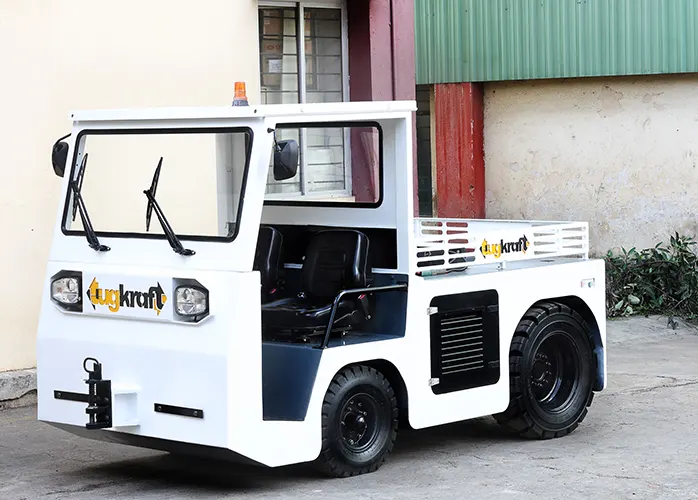
- Baggage tractors: Tow baggage trailers to/from an aircraft
- GPU (Ground Power Units): Provide power when the plane’s engines are not running.
- Air stairs: Mobile stairs for boarding of passengers (when terminal gates are not available)
- Catering trucks: Used to load food, beverages, and onboard supplies
- Toilet service vehicles: Used for aircraft lavatory servicing and waste disposal
- De-icing trucks: Clear ice/snow during winter (safety issues)
- Pushback tugs: Used to push or tow aircraft away from parking stands before taxiing.
Role of GHE in Airports – Why It Matters
Rapid aircraft turnaround: Airline companies have very short schedules. This requires seamless coordination between ground handling teams and equipment.
Efficiency in moving cargo: Air cargo moves high-value goods around the world every day, making efficient cargo handling essential. Cargo loaders and baggage systems load and unload goods fast, helping to reduce costs of time on the ground at the airport.
Safety compliance: Ground handling personnel undergo specialised training to ensure safe aircraft servicing and equipment operation. De-icing equipment keeps accidents from happening. Ground Power Units (GPUs) provide electrical power to aircraft while the engines and onboard auxiliary systems are not operating.
Cost management: Efficient GHE decreases the aircraft turnaround time and can help reduce operational costs associated with delays and extended ground time.
GHE vs GSE – What’s the Difference?
| Aspect | GHE | GSE |
| Definition | Handling aircraft equipment, luggage and passengers | Ground Support Equipment (more generic term) |
| Scope | Cargo/baggage/passenger loading | Also has catering, cleaning and servicing |
| Location | Ramp/tarmac areas | Ramp + terminal areas |
| Examples | Baggage tractors, cargo loaders and air stairs | GPUs, snow removal vehicles, food trucks |
| Regulation | DGCA (India), FAA (USA) standards are adhered to | Similar regulatory framework |
The terms GHE and GSE are often used interchangeably. In some contexts, GHE refers specifically to equipment used for baggage, cargo, and passenger handling, while GSE is a broader term covering all aircraft support equipment.
Types of GHE in Airports
1. Cargo Handling Equipment
Cargo loaders
- Used to raise cargo containers and pallets to aircraft cargo-door height, depending on aircraft type.
- Lifts with motorized equipment
- The plane is used on: Narrow-body and wide-body cargo aircraft.
- Cost: ₹50-100 lakhs (Rental costs vary based on equipment type, capacity, location, and contract duration.)
2. Baggage Handling Equipment
Baggage tractors
- Baggage tractors tow multiple baggage trailers between terminals and aircraft.
- Speed: 40-50 km/h max
- Applications: Used across a wide range of aircraft operations.
- Cost: ₹20-40 lakhs (rental ₹10,000-20,000/month)
3. Passenger Boarding Equipment
Air stairs
- Mobile stairs to assist when gates are not available.
- Raising height: Adjustable to accommodate different aircraft door heights.
- Cost: ₹30-50 lakhs (rental ₹15,000-25,000/month)
4. Aircraft Servicing Equipment
GPU (Ground Power Units)
- Supplies electricity to an aircraft.
- Supplies electrical power to aircraft systems while engines are shut down.
- Capacity: 60-120 kVA
- Cost: ₹40-80 lakhs
5. De-icing Equipment
De-icing trucks
- Spray heated fluid on aircraft fuselage to remove ice/snow
- Essential in regions that experience snow and ice conditions.
- Rental options are also available seasonally.
6. Pushback Tugs
- Used to push aircraft back from parking bays before taxiing
- Capacity varies by model and aircraft type, ranging from regional aircraft to large wide-body aircraft.
- Cost: ₹100-200 lakhs (rental ₹40,000-80,000/month)
Safety Measures in Ground Handling Operations
Ground handling has always been a risky business. Employees are exposed to aircraft, heavy equipment, schedules and more.
Safety protocols:
- Training & Certification: All GHE operators trained in Aircraft Safety procedures, Low visibility operations, Emergency procedures
- Speed limits: Ramp speed limits are enforced to reduce the risk of collisions.
- Positioning: Operators maintains a safe distance between spinning propellers, jet engines
- Visibility: Ground handling equipment is fitted with safety lighting, reflectors, and appropriate warning markings.
- Communication: Ground crews are equipped with headsets and are able to communicate with the aircraft crew via radio
- Weather protocols: If weather is extremely bad, Operations may be restricted or modified during severe weather conditions in accordance with airport safety procedures.
- Incident reporting: Any near miss or accident reported and investigated
Key Takeaway
Ground Handling Equipment plays a critical role in ensuring safe, efficient, and timely aircraft operations. Well maintained and operated, quality GHE is the difference between smooth airport operation and costly delays.
In charge of airport cargo? Mazda Movers provides effortless Ground Handling Equipment service solutions, from cargo loaders to baggage tractors, ensuring operator training and compliance, and providing maintenance support.
Connect now and let us take care of airport ground handling operation requirements.
Also, follow us on Instagram, Facebook and LinkedIn for insights on fleet modernization, automation trends, and advanced logistics strategies.