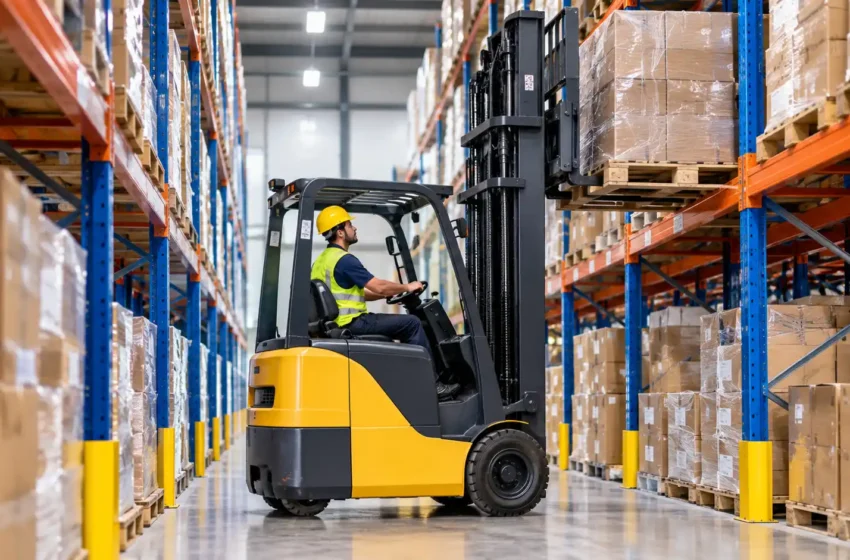
Choosing the right forklift for narrow aisles and high-rack warehouses requires evaluating aisle width, storage height, pallet dimensions, load weight, turning clearance, and floor conditions. Reach trucks, narrow-aisle forklifts, and very narrow aisle (VNA) equipment are common options for high-density warehouse operations.
The right choice depends on the warehouse layout and handling requirements. Businesses should also consider lifting capacity at the required height, battery performance, operator visibility, and equipment utilisation before purchasing or arranging forklift rental.
Key Takeaways
- Measure aisle width and rack height before selecting a forklift.
- Reach trucks and VNA forklifts are suitable for specific high-density storage applications.
- Electric forklifts are often preferred for indoor warehouse operations.
- Lifting capacity can change with mast height, load centre, and attachments.
- Rental and maintenance arrangements can help businesses manage changing equipment requirements.
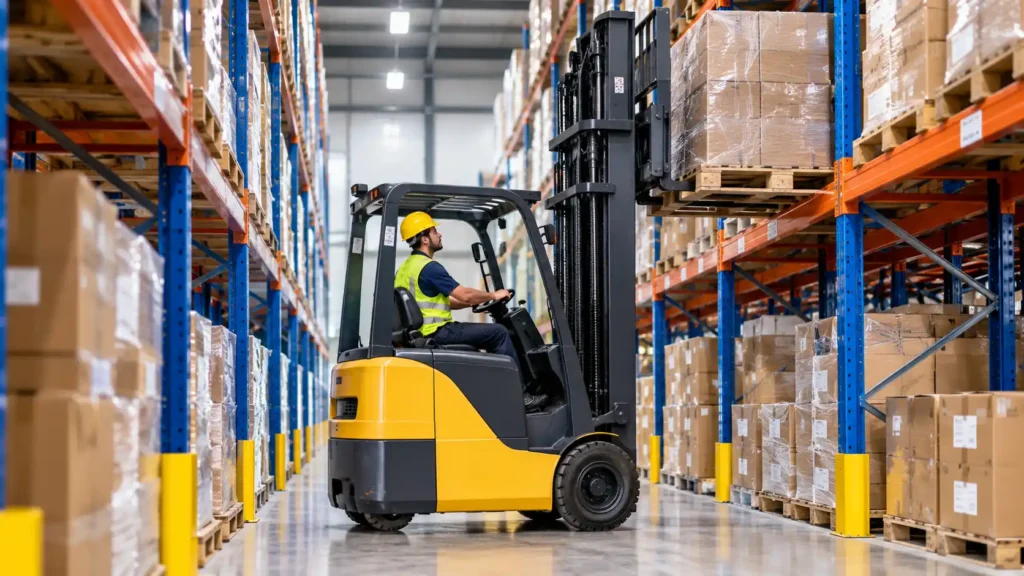
Finding the Right Forklift for Space-Constrained Warehouse Layouts
Modern warehouses need to accommodate increasing inventory volumes without continuously expanding their floor space. High-rack storage systems and narrow aisles help businesses maximise available storage capacity while organising material movement.
However, these layouts require specialised material-handling equipment. A conventional forklift may not have sufficient manoeuvrability to operate comfortably between closely positioned racks. Similarly, a forklift with inadequate lifting height or capacity may not safely retrieve pallets from upper storage levels.
Selecting a suitable forklift for narrow aisles involves understanding the relationship between warehouse dimensions, storage configuration, load characteristics, and equipment capability.
For warehouses, automotive facilities, manufacturing units, and aviation-related operations, the right forklift configuration can support better storage accessibility and material-handling efficiency.
What Should You Evaluate Before Selecting a Narrow-Aisle Forklift?
1. How Much Aisle Width Does Your Warehouse Require?
Aisle width determines how comfortably a forklift can travel, turn, position itself, and retrieve pallets.
Different forklift configurations require different operating clearances. Counterbalance forklifts generally need more manoeuvring space than specialised narrow-aisle equipment.
Before selection, measure:
- Clear aisle width between racks.
- Pallet dimensions and load overhang.
- Turning and positioning clearance.
- Rack-end space.
- Loading and unloading areas.
Always compare these measurements with the manufacturer’s specified working aisle requirements for the actual load and pallet configuration.
2. What Lifting Height Is Required?
High-rack warehouses require forklifts capable of accessing elevated storage positions.
However, maximum lifting height alone does not determine suitability. The available lifting capacity at the intended height must also be considered.
Evaluate the rack’s highest storage position, pallet weight, load centre, mast configuration, and manufacturer-rated capacity.
3. Should You Choose an Electric Forklift?
Electric forklifts are commonly used for indoor warehouse operations because they produce no exhaust emissions at the point of operation.
They can be suitable for facilities where indoor air quality and noise levels are important considerations.
However, businesses must assess battery capacity, charging infrastructure, operating hours, and charging time, particularly when warehouses operate multiple shifts.
4. Can Your Warehouse Floor Support High-Rack Operations?
High-rack material handling requires appropriate floor conditions.
Uneven flooring, damaged surfaces, and inadequate load-bearing capacity can affect equipment stability and safe movement, particularly during elevated pallet handling.
Assess floor flatness, levelness, structural capacity, and compatibility with the selected forklift.
MHE Selection Table: Which Forklift Is Suitable?
| Warehouse application | Equipment to consider | Key selection factor |
|---|---|---|
| Standard warehouse aisles | Electric counterbalance forklift | Turning clearance |
| Narrow storage aisles | Narrow-aisle forklift | Working aisle width |
| High-rack pallet retrieval | Reach truck | Lifting height and capacity |
| Very narrow aisle storage | VNA forklift | Rack configuration and guidance |
| Indoor pallet transportation | Electric warehouse forklift | Battery performance |
| Mixed indoor and outdoor handling | Suitable electric or IC forklift | Operating environment |
Equipment suitability should always be verified against manufacturer specifications and actual site conditions.
What Operational Challenges Can an Incorrect Forklift Create?
An unsuitable forklift can affect warehouse operations beyond the immediate handling process.
- Restricted manoeuvrability: Larger equipment may struggle to turn within narrow aisles.
- Reduced storage accessibility: Inadequate lifting height can limit access to upper rack levels.
- Rack damage: Poor positioning and restricted visibility can increase accidental contact.
- Handling delays: Repeated repositioning can slow pallet retrieval and storage.
- Equipment downtime: Operating equipment outside its intended application can increase maintenance requirements.
- Safety concerns: High-level lifting requires appropriate visibility, operator training, and stable working conditions.
These challenges can affect inventory movement, warehouse productivity, and dispatch schedules.
How to Choose the Right Forklift: A Step-by-Step Framework
Step 1: Measure aisle dimensions
Record the clear width of all operating aisles, including the narrowest sections. Account for pallet overhang and turning clearance.
Step 2: Identify storage height
Determine the maximum pallet storage height and required lifting height. Check the forklift’s rated capacity at the intended height.
Step 3: Assess load characteristics
Record pallet dimensions, weight, load centre, and weight distribution. Consider whether specialised attachments are required.
Step 4: Evaluate floor conditions
Inspect floor flatness, levelness, load-bearing capacity, and surface condition.
Step 5: Calculate equipment utilisation
Estimate pallet movements, operating hours, workload distribution, and shift requirements.
Step 6: Compare forklift configurations
Evaluate reach trucks, VNA forklifts, narrow-aisle forklifts, and electric counterbalance forklifts according to the application.
Step 7: Conduct a site suitability assessment
Verify manufacturer specifications and assess the proposed equipment in relation to the warehouse layout before deployment.
When Should Businesses Consider Electric Forklift Rental?
Purchasing specialised equipment may not always be practical, particularly when warehouse requirements change.
Electric forklift rental can be useful when:
- A warehouse is expanding its high-rack storage capacity.
- Existing equipment cannot operate comfortably in restricted aisles.
- Businesses need additional equipment during seasonal demand.
- A facility is evaluating a new storage configuration.
- Temporary projects require specialised warehouse equipment.
Rental can provide access to suitable equipment without requiring an immediate long-term purchase commitment.
For businesses with continuous material-handling requirements, regular maintenance and annual maintenance contracts can also support equipment upkeep and planned servicing.
Cost Considerations for Narrow-Aisle Forklifts
The overall cost of a forklift includes more than its purchase or rental price.
| Cost factor | What to evaluate |
|---|---|
| Equipment investment | Purchase or rental cost |
| Energy consumption | Electricity or fuel requirements |
| Battery management | Charging infrastructure and battery replacement |
| Maintenance | Scheduled servicing and component replacement |
| Downtime | Lost productivity during equipment breakdowns |
| Operators | Training and operating requirements |
| Attachments | Compatibility and impact on rated capacity |
| Utilisation | Operating hours and pallet movements |
| Infrastructure | Rack compatibility and floor improvements |
A specialised forklift may involve higher investment, but it can be appropriate when it supports better warehouse space utilisation. Businesses should compare total operating costs against expected usage and productivity requirements.
Narrow-Aisle Warehouse Considerations for Indian Industries
Indian warehouses and manufacturing facilities increasingly need to organise inventory within available infrastructure.
Automotive warehouses handle components, spare parts, and assemblies that may require high-density storage. Manufacturing facilities need efficient movement of raw materials and finished products, while logistics centres manage different pallet sizes and dispatch schedules.
Important considerations include:
- Floor flatness and levelness for high-rack operations.
- Suitable battery charging arrangements.
- Warehouse ventilation and operating conditions.
- Compatibility between pallets and storage racks.
- Monsoon-related water ingress and floor maintenance.
- Availability of trained operators for specialised equipment.
These factors are particularly important when upgrading an existing warehouse rather than developing a new facility.
Common Mistakes to Avoid
- Selecting equipment without measuring aisle width.
- Choosing a forklift based only on maximum lifting capacity.
- Ignoring capacity changes at higher lifting heights.
- Overlooking pallet dimensions and load overhang.
- Using conventional forklifts in unsuitable narrow aisles.
- Ignoring floor conditions and rack clearances.
- Underestimating battery charging requirements.
- Failing to train operators on specialised equipment.
- Ignoring maintenance and equipment utilisation.
Industry Insight: Matching Equipment to Warehouse Layout
At Mazda Movers, we recognise that warehouse efficiency depends on how well material-handling equipment fits the available infrastructure.
A forklift that performs effectively in a conventional warehouse may not be suitable for high-density storage with restricted aisles. Similarly, selecting equipment based only on lifting height without considering load capacity, manoeuvrability, and floor conditions can create operational difficulties.
Our approach is to evaluate aisle dimensions, storage height, pallet characteristics, operating frequency, and maintenance requirements together when assessing forklift requirements.
How to Choose the Right MHE Partner
Before selecting a forklift supplier or rental provider, evaluate:
- Equipment range: Are suitable forklifts available for narrow-aisle and high-rack applications?
- Technical assessment: Can the provider evaluate aisle dimensions and load requirements?
- Rental flexibility: Are suitable short-term and long-term rental arrangements available?
- Maintenance support: Are servicing and AMC options offered?
- Equipment condition: Are inspection and maintenance practices followed?
- Operational understanding: Does the provider understand warehouse material-handling requirements?
A suitable MHE partner should understand your warehouse layout before recommending equipment.
Why Mazda Movers?
Mazda Movers provides forklift rental, material-handling equipment solutions, maintenance support, and annual maintenance contracts.
For businesses reviewing warehouse equipment requirements, Mazda Movers can help explore suitable forklift solutions based on operational needs, equipment utilisation, and maintenance considerations.
Whether you are expanding storage capacity or reviewing equipment for restricted warehouse aisles, choosing the right forklift configuration is an important starting point.
Key Takeaway: Match Forklift Capability to Warehouse Space
Choosing the right forklift for narrow aisles requires more than selecting compact equipment. Businesses must evaluate aisle width, rack height, load dimensions, lifting capacity, floor conditions, and daily utilisation.
The right equipment can support better warehouse accessibility and more organised material movement.
If you are planning a high-rack warehouse or need equipment for restricted aisles, connect with Mazda Movers to explore suitable warehouse forklift solutions and electric forklift rental options.
Frequently Asked Questions
Q1. Which forklift is best for narrow aisles?
Reach trucks and specialised narrow-aisle forklifts are common options. Selection depends on aisle width, pallet dimensions, and lifting height.
Q2. Are electric forklifts suitable for high-rack warehouses?
Yes. Suitable electric forklifts and reach trucks can support indoor high-rack operations, subject to capacity, lifting height, and floor requirements.
Q3. How wide should an aisle be for a forklift?
There is no universal aisle width. It depends on the forklift model, pallet dimensions, load overhang, and manufacturer-specified working aisle requirements.
Q4. Can a reach truck operate in narrow warehouse aisles?
Yes. Reach trucks are designed for warehouse applications requiring pallet handling in comparatively restricted aisles and at elevated storage positions.
Q5. When should businesses consider electric forklift rental?
Rental is useful when businesses need temporary equipment, additional warehouse capacity, or an opportunity to evaluate forklift configurations before purchasing.
Related Reads
The right narrow-aisle forklift depends on the layout it has to work in. If you read one more guide, we recommend Warehouse Layout & Forklift Choice: Layouts That Reduce Travel Time and Accidents, which shows how layout and forklift choice work together to cut travel time and accidents. The other two cover which equipment to order first and how to choose between electric and diesel power.