Quick Answer
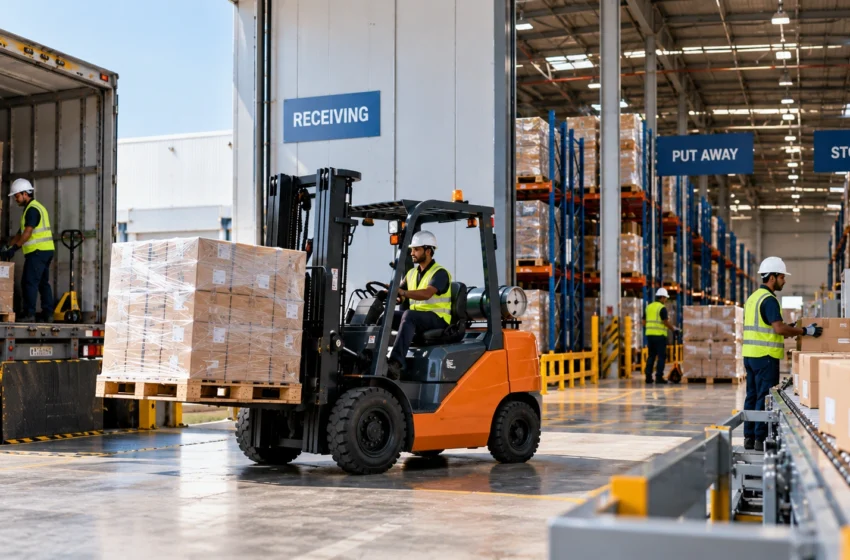
Dock-to-stock time is the time taken to move incoming goods from the receiving dock to their designated storage location and make them available for inventory operations. Reducing this time requires a coordinated process covering unloading, inspection, identification, material movement, put-away and inventory updates.
Better material handling equipment can support this process by reducing unnecessary movement, improving load handling and keeping receiving operations moving. The right forklift, pallet-handling equipment and MHE rental services can be particularly useful when equipment requirements change with volume, facility expansion or temporary demand.
Key Takeaways
- Map the complete receiving-to-storage process before trying to reduce dock-to-stock time.
- Match MHE to load type, movement distance, storage layout and handling frequency.
- Reduce waiting time between unloading, inspection, inventory processing and put-away.
- Prevent equipment downtime through planned maintenance and timely service support.
- Use forklift rental services or other MHE options when additional handling capacity is required temporarily.
What Is Dock-to-Stock Time and Why Does It Increase?
Dock-to-stock time covers more than the physical movement of goods. A shipment may reach the dock quickly but still take considerable time to become available in storage if there are delays in inspection, documentation, equipment availability or put-away.
Common causes include:
- Congested receiving areas
- Waiting for forklifts or operators
- Manual movement of palletised goods
- Poor storage-location planning
- Equipment breakdowns
- Repeated handling of the same load
- Delays in identification or inventory processing
- Mismatch between equipment and load requirements
Reducing these delays requires looking at the entire material flow rather than focusing only on forklift speed.
Where Do Material-Handling Bottlenecks Occur?
Is unloading taking too long?
If vehicles wait because unloading equipment is unavailable, the receiving dock can quickly become congested.
The business should assess whether the available forklifts or other MHE can handle the volume and type of incoming loads at the required rate.
Are goods waiting after unloading?
A pallet may be unloaded successfully but remain in the receiving area while waiting for inspection, scanning, documentation or storage allocation.
Clear receiving procedures and coordination between warehouse and inventory teams can reduce this idle time.
Is put-away creating delays?
Long travel distances, congested aisles or unsuitable equipment can slow movement from the dock to the storage location.
Warehouse layout and MHE selection should therefore be considered together.
MHE Selection Table
| Handling Requirement | MHE to Consider | Operational Benefit |
|---|---|---|
| Pallet unloading | Forklift | Efficient movement of palletised loads |
| Repetitive pallet movement | Forklift | Supports regular receiving and put-away |
| Short-distance warehouse movement | Pallet-handling equipment | Reduces unnecessary forklift use |
| Different load sizes | Suitable forklift/attachments | Better load handling flexibility |
| Temporary increase in receiving volume | Rental MHE | Adds handling capacity without immediate purchase |
| Equipment replacement during maintenance | Rental forklift | Helps maintain operational continuity |
The appropriate equipment depends on the load, site conditions, storage layout and operating requirements.
How Can Better Material Handling Reduce Dock-to-Stock Time?
Reduce unnecessary movement
Every additional movement adds handling time. Plan the receiving and put-away process so goods move through the fewest practical stages.
Where possible, receiving zones, inspection points and storage locations should support a logical material flow.
Match equipment to the application
A forklift that is appropriate for one operation may not be ideal for another.
Consider:
- Load weight and dimensions
- Lift height
- Aisle width
- Travel distance
- Indoor or outdoor operation
- Surface conditions
- Handling frequency
- Required attachments
The objective is not simply to use more equipment. It is to use suitable equipment where it provides the greatest operational value.
Keep critical equipment available
A breakdown during a busy receiving period can create a queue of vehicles, pallets and warehouse tasks.
Preventive maintenance and AMC support can help businesses plan maintenance rather than relying entirely on reactive repairs.
A Practical Framework for Reducing Dock-to-Stock Time
Step 1: Map the receiving process — Track the movement from vehicle arrival through unloading, inspection, identification and final storage.
Step 2: Measure waiting points — Identify where goods, operators or vehicles spend time waiting.
Step 3: Assess MHE utilisation — Determine whether forklifts and other equipment are being overused, underused or deployed for tasks they are not suited to perform.
Step 4: Improve the material flow — Reduce unnecessary travel, double handling and movement between temporary storage areas.
Step 5: Establish equipment maintenance routines — Schedule preventive maintenance around operational requirements and address recurring equipment issues.
Step 6: Review the process regularly — Changes in inventory volume, product mix, warehouse layout or receiving schedules can change MHE requirements.
When Can MHE Rental Help?
Not every warehouse needs to purchase additional equipment when receiving volumes increase.
MHE rental services can be considered when businesses face:
- Seasonal demand
- Temporary increases in inbound shipments
- New warehouse operations
- Expansion projects
- Temporary equipment replacement
- Short-term contracts
- Additional handling requirements during peak periods
Similarly, forklift rental services can provide an option when additional forklift capacity is required without committing immediately to equipment ownership.
Rental decisions should still be based on the actual application, utilisation and required support.
Cost Considerations
Reducing dock-to-stock time is not simply about acquiring faster equipment.
Businesses should consider the total operating cost, including:
- Equipment rental or ownership cost
- Operator availability
- Fuel or electricity consumption
- Maintenance
- Spare parts and service requirements
- Equipment downtime
- Attachments, where required
- Utilisation levels
- Travel distance within the facility
- Cost of repeated or unnecessary handling
An equipment option that has a higher rental rate may still be operationally appropriate if it reduces bottlenecks and is better suited to the application. The complete cost and workflow should therefore be evaluated together.
India-Specific Warehouse and Manufacturing Considerations
Indian businesses operate a wide range of warehousing, manufacturing, automotive, logistics and retail facilities. Receiving conditions can differ significantly between a distribution warehouse, manufacturing plant and large retail operation.
Material flow may also change during seasonal demand, production fluctuations or facility expansion.
This makes flexible MHE planning important. Businesses should regularly review whether their existing equipment matches current load profiles, storage layouts and receiving volumes.
Common Mistakes to Avoid
- Measuring only unloading time instead of the complete receiving process
- Adding forklifts without identifying the actual bottleneck
- Using unsuitable equipment for specific loads
- Ignoring equipment downtime
- Allowing receiving areas to become temporary storage zones
- Creating unnecessary double handling
- Failing to coordinate operators and warehouse teams
- Delaying preventive maintenance
- Not reviewing MHE requirements after layout or volume changes
Industry Insight
At Mazda Movers, we look at material handling as part of the overall workflow rather than treating the forklift as an isolated piece of equipment.
When businesses want to improve receiving and put-away, the first step is understanding where time is actually being lost. Equipment availability is important, but so are load characteristics, movement distances, storage arrangements and maintenance practices.
The right MHE should support the process. Simply adding more equipment without addressing the underlying bottleneck may not produce the expected improvement.
How to Choose an MHE Partner
Before selecting a forklift or MHE provider, consider:
- Ability to understand the actual application
- Suitable range of material handling equipment
- Forklift and attachment options
- Rental flexibility
- Preventive maintenance and AMC support
- Breakdown and service response
- Equipment availability
- Clarity of rental and service terms
- Support for changing operational requirements
A suitable partner should be able to discuss both the equipment requirement and the operational environment in which it will be used.
Why Mazda Movers?
Mazda Movers provides material-handling solutions including forklift rental, MHE solutions and AMC/maintenance support.
For businesses looking to improve receiving and put-away operations, these services can support temporary capacity requirements, equipment replacement and ongoing material-handling needs.
Key Takeaway
Reducing dock-to-stock time starts with identifying where delays occur between unloading and final put-away. Better equipment can help, but the biggest gains come from combining suitable MHE with efficient material flow, equipment availability, maintenance and clear operating processes.
If your warehouse or facility is reviewing its forklift or MHE requirements, discussing the application with an experienced material-handling provider can help identify suitable equipment and support options.
FAQs
Q1. What is dock-to-stock time?
A. Dock-to-stock time is the time taken to move incoming goods from the receiving dock to their designated storage location and make them available for inventory operations.
Q2. How can forklifts reduce dock-to-stock time?
A. Suitable forklifts can support faster unloading, transportation and put-away of palletised goods when matched correctly to the load and warehouse environment.
Q3. Can forklift rental help reduce dock-to-stock time?
A. Yes. Forklift rental services can provide additional handling capacity during temporary demand, expansion, equipment replacement or seasonal requirements.
Q4. What causes high dock-to-stock time?
A. Common causes include equipment waiting, manual handling, receiving congestion, poor material flow, equipment breakdowns, repeated handling and delays in inventory processing.
Q5. How should MHE be selected for warehouse receiving?
A. Consider load characteristics, lift height, aisle width, travel distance, operating environment, utilisation and maintenance requirements before selecting the equipment.