Quick Answer
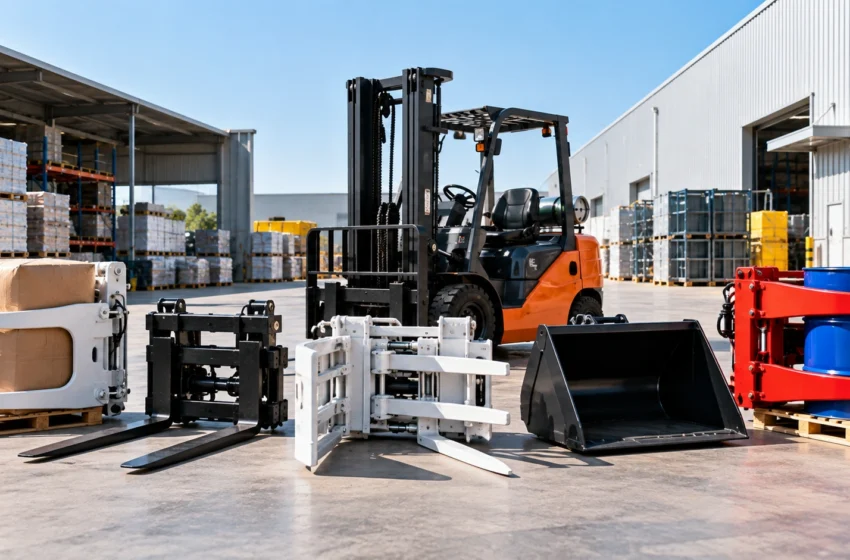
Forklift attachments are accessories fitted to a forklift to handle specific types of loads more efficiently than standard forks. Common options include side shifters, fork positioners, clamps, rotators, drum handlers and specialised load-handling attachments.
The right attachment depends on the load type, weight, dimensions, shape, handling method and operating environment. Choosing an attachment should also account for its effect on the forklift’s rated capacity and load centre. The objective is to select an attachment that matches the actual handling requirement without compromising equipment suitability, stability or safe operation.
Key Takeaways
- Forklift attachments allow standard forklifts to handle specialised loads.
- Attachment selection should begin with the load, not the accessory.
- Load centre and residual capacity should be considered when adding an attachment.
- The right attachment can improve handling efficiency and reduce unnecessary manual movement.
- Businesses using forklift rental services should confirm attachment compatibility before finalising the equipment.
Why Do Businesses Need Forklift Attachments?
Standard forks work well for many palletised loads, but not every material is packaged or positioned in the same way.
Manufacturing facilities may handle coils, drums or unusual components. Warehouses may move different pallet sizes. Construction sites can encounter irregular materials, while automotive and industrial operations may require specialised handling methods.
Instead of using manual handling or purchasing a separate machine for every application, a suitable attachment can expand the functionality of an existing forklift.
The important consideration is selecting an attachment based on the actual load and workflow.
Which Forklift Attachment Is Suitable for Different Loads?
Side Shifter for Position Adjustment
A side shifter allows the forks to move laterally without repositioning the entire forklift.
It can be useful when:
- Pallets need precise positioning
- Loading space is restricted
- Operators frequently need to align forks
- Warehouse handling involves repetitive pallet movement
Fork Positioner for Different Pallet Widths
Fork positioners allow the distance between forks to be adjusted hydraulically.
They can be useful when handling loads with varying pallet or load dimensions, reducing the need for manual fork adjustment.
Drum Handler for Drums
Drum-handling attachments are designed specifically for moving drums.
They can be relevant in manufacturing, chemical, industrial and warehouse environments where drums need to be picked, transported or positioned.
Rotator for Controlled Load Rotation
Rotators allow the load to be turned through the attachment mechanism.
They may be useful where materials need to be inverted or rotated as part of the handling process, subject to the specific attachment and load requirements.
Clamps for Non-Palletised Loads
Clamps can hold certain loads without requiring conventional pallet support.
Depending on the clamp design, applications can include handling products or materials where using standard forks may not provide appropriate load control.
MHE Selection Table
| Load or Requirement | Attachment to Consider | Typical Application |
|---|---|---|
| Standard palletised goods | Standard forks | Warehouses and distribution |
| Pallets requiring lateral positioning | Side shifter | Warehousing and loading |
| Different fork spacing requirements | Fork positioner | Manufacturing and logistics |
| Drums | Drum handler | Industrial and manufacturing operations |
| Loads requiring rotation | Rotator | Selected production and handling applications |
| Suitable non-palletised loads | Load clamp | Specific industrial applications |
| Special or irregular loads | Application-specific attachment | Manufacturing and specialised handling |
The final attachment should always be selected according to the manufacturer’s specifications and the actual load-handling application.
What Challenges Can the Right Attachment Solve?
Can attachments reduce handling bottlenecks?
A suitable attachment can make certain handling movements more direct. For example, being able to adjust fork spacing or position a load without repeatedly repositioning the forklift can improve workflow efficiency.
Can attachments improve equipment utilisation?
A properly selected attachment can allow one forklift to perform different handling tasks. However, this does not mean every attachment is suitable for every forklift.
Can the wrong attachment create safety concerns?
Yes. Attachments affect the way a forklift handles a load. Their weight and design can change the effective load capacity and load centre.
Businesses should therefore never assume that an attachment can be fitted and used simply because it physically connects to the forklift.
How Should You Choose a Forklift Attachment?
A practical selection process starts with the load.
Step 1: Identify the load — Record the weight, dimensions, shape, packaging and stability of the load.
Step 2: Understand the handling movement — Determine whether the load needs to be lifted, shifted, rotated, clamped, tipped or positioned.
Step 3: Check the operating environment — Consider warehouse aisles, loading bays, floor conditions, available space and indoor or outdoor operation.
Step 4: Check forklift compatibility — Confirm that the forklift and attachment are compatible and that the combined configuration is suitable for the intended application.
Step 5: Assess capacity and load centre — The attachment itself adds weight and can affect the forklift’s capacity characteristics. These factors must be assessed before operation.
Step 6: Review operator requirements — Operators should understand the attachment’s controls, limitations and correct handling procedure.
When Does Renting a Forklift With Attachments Make Sense?
Businesses do not always need to purchase specialised equipment for every handling requirement.
Forklift rental services can be considered for:
- Temporary projects
- Seasonal warehouse requirements
- Short-term changes in material types
- Replacement equipment requirements
- New operations where equipment requirements are still being assessed
- Applications requiring specialised attachments for a limited period
Similarly, material handling equipment rental can provide flexibility when businesses want to match equipment availability with changing operational requirements.
The attachment requirement should be communicated at the beginning of the rental discussion so the forklift and attachment can be evaluated as one handling system.
Cost Considerations
The cost of an attachment should not be evaluated separately from the overall operation.
Businesses should consider:
- Attachment purchase or rental cost
- Compatibility with the forklift
- Installation requirements
- Maintenance and inspection
- Effect on usable forklift capacity
- Operator training or familiarisation
- Fuel or electricity consumption
- Potential productivity improvements
- Downtime associated with unsuitable equipment
- Frequency of attachment use
If a specialised attachment is required only occasionally, renting may be worth comparing with purchasing. For frequent, long-term use, businesses can evaluate the economics of owning the attachment alongside the required forklift.
India-Specific Considerations
Indian warehouses, manufacturing facilities, automotive operations and industrial sites can involve varied load types and handling conditions.
For example, palletised products may dominate one warehouse while drums, components, packaged materials or specialised industrial loads may be more common in another facility.
This makes application assessment particularly important. Businesses should consider the actual material, storage arrangement, movement pattern and working environment rather than selecting an attachment based only on its general category.
Common Mistakes Businesses Should Avoid
- Choosing an attachment based only on price
- Ignoring the load centre
- Assuming every attachment fits every forklift
- Not checking the forklift’s capacity with the attachment installed
- Using a specialised attachment for an unsuitable load
- Forgetting installation and maintenance requirements
- Not considering aisle and operating-space limitations
- Failing to familiarise operators with the attachment
- Renting equipment without clearly specifying the attachment requirement
- Treating the attachment as separate from the complete material-handling system
Industry Insight
At Mazda Movers, we approach attachment selection from the handling requirement first.
A forklift attachment is useful when it solves a specific handling problem. The important part is understanding what the load requires and then determining whether the forklift, attachment and operating environment work together appropriately.
For businesses, this approach can be more useful than simply asking which attachment is most popular or least expensive. The attachment should support the application without creating a mismatch between the load, equipment and operating conditions.
How to Choose an MHE Partner
Before selecting a forklift or attachment provider, businesses should check:
- Understanding of the intended application
- Availability of suitable forklift and MHE options
- Attachment compatibility
- Capacity and load-centre assessment
- Installation and maintenance support
- Rental flexibility
- Breakdown and service support
- Clarity of rental or service terms
- Operator support or guidance, where applicable
A good MHE partner should help evaluate the complete handling requirement rather than supplying an attachment in isolation.
Why Mazda Movers?
Mazda Movers supports businesses with forklift rental, material handling equipment solutions and AMC/maintenance services.
For businesses evaluating specialised forklift requirements, the focus can be on matching the equipment and attachment to the application while also considering ongoing maintenance and operational support.
Key Takeaway
The right forklift attachments can extend the usefulness of a forklift and make specialised load handling more practical. However, the attachment should always be selected based on the load, handling movement, forklift compatibility, capacity and operating environment.
If your business is evaluating forklift rental or specialised MHE requirements, discuss the actual load and application with an experienced material-handling provider before selecting the equipment.
FAQs
Q1. What are forklift attachments?
A. Forklift attachments are accessories fitted to forklifts to handle specific loads or perform tasks that standard forks may not be designed for.
Q2. Which forklift attachment is best for drums?
A. A drum-handling attachment is designed for handling drums, but the appropriate configuration depends on the drum type, weight, handling method and compatible forklift.
Q3. Do forklift attachments reduce forklift capacity?
A. An attachment can affect the forklift’s rated capacity and load-centre characteristics. The complete forklift and attachment configuration should be assessed before use.
Q4. Can I rent a forklift with an attachment?
A. Yes, depending on availability and the rental provider’s equipment range. Businesses should specify the required attachment when enquiring about forklift rental services.
Q5. How do I choose the right forklift attachment?
A. Start with the load’s weight, dimensions, shape and handling requirements. Then check the operating environment, forklift compatibility, capacity and attachment specifications.