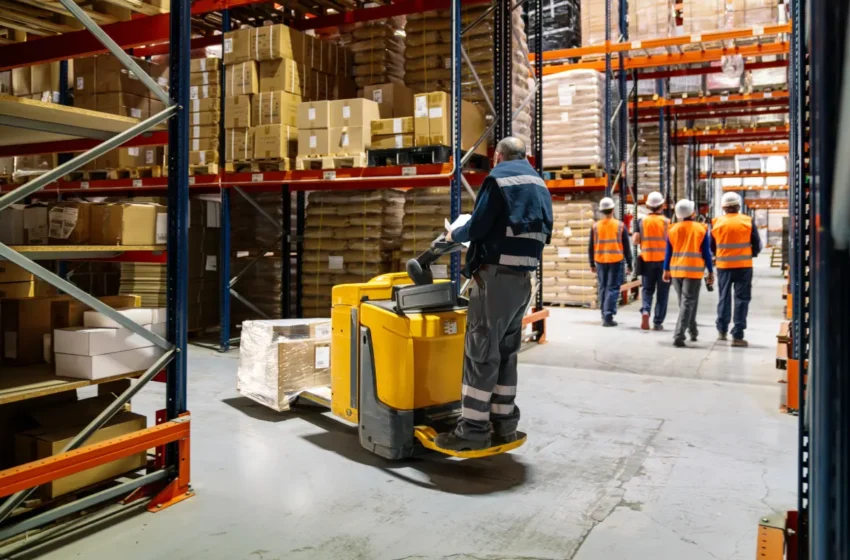
Quick Answer: Your warehouse may need additional material handling equipment when queues, delayed put-away, missed dispatch windows, excessive forklift utilisation or recurring equipment conflicts become consistent rather than occasional. Before adding machines, check whether the bottleneck is genuinely equipment capacity. Measure material movements, cycle times, peak-hour demand, equipment availability and warehouse layout to determine whether extra forklifts, reach trucks, pallet trucks or other MHE will improve operations.
Key Takeaways
- Repeated queues and delayed pallet movements can indicate insufficient MHE capacity.
- High equipment utilisation alone does not prove that another machine is required.
- Measure peak-period workloads rather than relying only on daily averages.
- The right solution may be a different equipment type, not simply another forklift.
- MHE rental services can provide temporary capacity for seasonal peaks, expansion or uncertain demand.
Warehouses rarely become short of equipment overnight. The warning signs usually appear gradually.
Inbound trucks wait slightly longer. Put-away starts carrying into the next shift. Operators compete for the same forklift. Dispatch teams begin requesting equipment urgently at predictable times each day.
These symptoms may indicate that your existing material handling equipment can no longer keep pace with warehouse activity. But adding more machines without diagnosing the problem can increase cost and congestion without increasing output.
The better approach is to determine where capacity is actually being lost.
Signs Your Warehouse May Need More Material Handling Equipment
Inbound Trucks Are Regularly Waiting for Equipment
If vehicles arrive on schedule but unloading is repeatedly delayed because forklifts are unavailable, receiving capacity may be insufficient.
Look beyond occasional peaks. A single unusually busy day does not justify permanent fleet expansion. Repeated queues at the same hours are more meaningful.
Put-Away or Replenishment Is Falling Behind
Received goods should move from staging into storage without creating persistent congestion.
Likewise, picking locations need timely replenishment.
If pallets remain in staging because reach trucks or forklifts are continuously occupied elsewhere, available MHE may not match the warehouse workload.
Operators Frequently Wait for a Machine
Labour can be available while work stops because equipment is not.
Track how often operators wait for:
- forklifts
- pallet trucks
- reach trucks
- stackers
- required attachments
If equipment sharing regularly interrupts productive work, the fleet may need adjustment.
Dispatch Deadlines Are Becoming Difficult to Meet
Outbound operations often create the most visible equipment shortages.
Orders may be packed and staged, but loading still falls behind because too few suitable machines are available during dispatch peaks.
When this happens repeatedly, additional equipment or better fleet allocation may be justified.
How to Check Whether Your Current MHE Capacity Is Sufficient
Do not judge capacity by counting machines alone.
A warehouse with eight forklifts may have less useful handling capacity than one with six well-matched machines.
Measure Material Movements
Count the movements required for:
- unloading
- put-away
- replenishment
- picking support
- internal transfers
- staging
- vehicle loading
Then separate normal workload from peak demand.
Calculate Cycle Time
A material-handling cycle includes more than lifting a pallet.
It can involve:
- travelling to the load,
- positioning the equipment,
- lifting,
- travelling to the destination,
- depositing the load,
- returning or moving to the next task.
Longer aisles, congested intersections or distant staging areas increase cycle time.
Measure Productive Equipment Hours
A ten-hour shift does not create ten productive equipment hours.
Actual availability may be reduced by:
- charging or refuelling
- inspections
- operator breaks
- maintenance
- waiting
- congestion
- attachment changes
Compare required MHE hours with realistic productive capacity.
Capacity Gap or Workflow Problem? Know the Difference
Additional material handling equipment helps only when equipment capacity is genuinely limiting the operation.
| Warehouse Symptom | Possible Cause |
| Trucks waiting at docks | Insufficient forklifts or poor dock scheduling |
| Pallets waiting for put-away | Reach-truck shortage or storage-location issue |
| Forklifts queuing in aisles | Congestion or poor layout |
| Operators waiting for equipment | MHE shortage or poor allocation |
| Dispatch backlog | Loading capacity, picking delay or staging problem |
| High forklift utilisation | Strong demand, inefficient travel or inadequate fleet |
| Frequent downtime | Maintenance issue rather than fleet quantity alone |
Before renting or purchasing more machines, observe where people, pallets and equipment are actually waiting.
If several forklifts are already queueing in the same aisle, another forklift may make matters worse.
When a Different Type of MHE Is the Better Answer
Warehouse growth does not always require more of the same equipment.
A counterbalance forklift is useful for many general handling tasks, but another equipment type may improve a specific workflow.
Reach Trucks for Racking
Higher storage density and taller racking may create a greater requirement for reach trucks rather than conventional forklifts.
Pallet Trucks for Horizontal Movement
If forklifts are spending significant time on short horizontal pallet transfers that do not require lifting to height, battery-operated pallet trucks may free them for more suitable work.
Articulated Forklifts for Restricted Aisles
Where aisle space is limited, equipment designed for narrower warehouse environments may be more appropriate.
Mazda Movers currently offers diesel and electric forklifts, battery-operated pallet trucks, stackers, reach trucks and articulated forklifts, along with specialised attachments.
The objective is therefore to increase useful handling capacity, not simply fleet size.
When Should You Use MHE Rental Services?
Rental can be practical when additional demand is real but may not be permanent.
Common situations include:
- seasonal warehouse peaks
- temporary production increases
- short-term projects
- warehouse relocation or expansion
- equipment breakdowns
- trialling a different MHE category
- uncertain future volumes
Mazda Movers currently provides short-term and long-term forklift and MHE rentals and states that its fleet can scale according to changing operational requirements.
Rental can therefore help businesses test whether additional equipment removes a bottleneck before committing to permanent fleet expansion.
Cost Factors Before Adding Warehouse Equipment
Do not compare options only by rental or purchase price.
Assess the wider operating cost, including:
- productive utilisation
- maintenance
- battery charging or fuel
- operators
- attachments
- equipment downtime
- mobilisation
- additional storage or parking space
- impact on truck waiting and dispatch performance
An additional forklift that remains idle for much of the day may add cost without meaningful output.
Conversely, higher-capacity or task-specific equipment may justify its cost if it removes a recurring constraint.
Material Handling Capacity in Indian Warehouses
Indian warehouses range from compact urban facilities to large distribution centres, industrial plants and logistics parks.
In space-constrained facilities around major cities, manoeuvrability and aisle design may matter as much as equipment quantity. Larger manufacturing and distribution sites may instead face long travel distances, multiple loading docks and simultaneous inbound and outbound peaks.
Mazda Movers currently supports material-handling operations across warehouses, logistics hubs, manufacturing units, ports and airports in India, with its headquarters in Mumbai.
The equipment decision should therefore be based on the individual site rather than a generic forklift-per-square-foot rule.
A Practical Checklist Before Adding More MHE
Before requesting more equipment, confirm:
- peak pallet or load movements
- average cycle times
- dock waiting periods
- current MHE utilisation
- equipment downtime
- load weight and dimensions
- maximum lift height
- aisle width
- travel distance
- shift pattern
- attachment requirements
- charging or refuelling arrangements
- operator availability
- whether demand is temporary or permanent
This gives an MHE provider enough information to recommend a suitable solution.
Common Mistakes When Expanding an MHE Fleet
Avoid:
- adding forklifts simply because the warehouse feels busy
- using daily averages instead of peak-hour demand
- overlooking equipment downtime
- ignoring aisle congestion
- using forklifts for tasks better suited to pallet trucks
- purchasing before temporary demand is proven
- selecting equipment only by lifting capacity
- failing to reassess the warehouse layout
- adding equipment without enough trained operators
A fleet decision should solve a clearly identified operational constraint.
Industry Insight: What We Look at When Businesses Ask for More Equipment
When businesses approach us saying they need additional forklifts or MHE, we generally start by asking where the delay occurs.
In our experience, that question often changes the equipment requirement.
If unloading is slow because every forklift is continuously occupied, adding capacity may make sense. But if forklifts are waiting for space inside a congested staging zone, another machine is unlikely to solve the problem.
We also see warehouses using counterbalance forklifts for almost every movement because those machines are already available. Sometimes a more task-specific piece of equipment can release existing forklift capacity without significantly increasing the overall fleet.
The important point is to diagnose the movement first and select the equipment second.
How to Choose a Warehouse Material Handling Solutions Partner
When comparing providers, ask whether they can assess:
- warehouse application
- equipment type and capacity
- rental duration
- attachment requirements
- shift intensity
- maintenance support
- breakdown assistance
- ability to scale equipment up or down
A capable provider of warehouse material handling solutions should ask about workload and site conditions before recommending fleet quantity.
How Mazda Movers Can Help Assess Your Additional MHE Requirement
Adding more material handling equipment should begin with understanding where the existing operation is losing capacity. Mazda Movers offers a range of forklifts and MHE, including diesel and electric forklifts, reach trucks, articulated forklifts, pallet trucks and stackers for different warehouse applications. The short- and long-term rental options can also help businesses respond to seasonal demand, expansion projects or temporary capacity gaps without immediately committing to permanent equipment.
When reviewing requirements, factors such as load profile, aisle width, lift height, travel distance, operating shifts and peak material movements should be considered together. This helps determine whether the warehouse needs additional equipment, a different MHE type or better allocation of its existing fleet. Maintenance and breakdown support can further help maintain equipment availability once the appropriate machines are deployed.
Conclusion
Your warehouse needs more material handling equipment when measured workload consistently exceeds available handling capacity, not simply when the operation feels busy.
Identify where pallets, vehicles and operators are waiting, determine whether equipment is genuinely the constraint, and then decide whether to add the same machine type or introduce more suitable MHE.
If your warehouse is approaching a capacity limit, Mazda Movers can review your operational requirements and discuss suitable MHE rental services before you commit to additional equipment.
Also, follow us on Instagram, Facebook and LinkedIn for insights on fleet modernisation, automation trends, and advanced logistics strategies.
FAQs
Q1. What are the signs that a warehouse needs more material handling equipment?
A. Recurring truck queues, delayed put-away, dispatch backlogs, operators waiting for equipment and consistently high MHE utilisation can indicate a capacity gap. Confirm the cause before adding machines.
Q2. How can businesses determine if their current MHE capacity is sufficient?
A. Measure peak material movements, cycle times, productive equipment hours, downtime and waiting periods. Compare required workload with the realistic capacity of the current fleet.
Q3. When should a company consider renting additional MHE?
A. Rental is useful when demand is seasonal, temporary, uncertain or linked to expansion, short-term projects or equipment downtime.
Q4. How does additional material handling equipment improve warehouse operations?
A. Additional equipment can reduce queues and improve loading, put-away or replenishment when insufficient MHE capacity is the genuine bottleneck.
Q5. What factors should be considered before adding new warehouse equipment?
A. Consider load weight, movement frequency, lift height, aisle width, travel distance, peak demand, equipment utilisation, attachments, operators, maintenance requirements and whether demand is temporary or long-term.