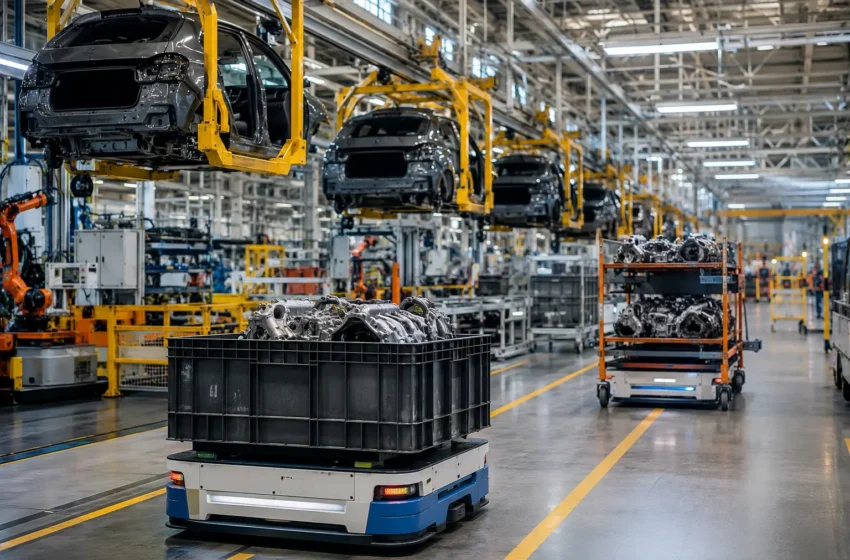
Quick Answer: Material handling in automotive industry operations involves moving components, sub-assemblies, tyres, dies, batteries, finished parts and other materials safely between receiving, storage, production and dispatch. The main challenges are maintaining line-side supply, handling different load types, avoiding aisle congestion, matching equipment to each task and preventing MHE downtime. Effective planning combines the right equipment, clear traffic flow, preventive maintenance and flexible capacity.
Key Takeaways
- Automotive material flow must support production without creating excess line-side inventory.
- Different loads may require forklifts, pallet trucks, reach trucks or specialised attachments.
- A forklift shortage is not always the problem. Layout, scheduling or unsuitable equipment may be the actual constraint.
- Equipment reliability is particularly important where MHE directly supports production lines.
- Forklift rental services can provide flexible capacity during production ramps, projects and temporary demand increases.
Automotive manufacturing depends on a continuous movement of material.
A vehicle or component plant may receive parts from multiple suppliers, transfer material into storage, replenish production areas, move work-in-progress and finally handle finished products or assemblies for dispatch. A delay at one stage can affect several downstream operations.
This makes material handling in automotive industry facilities different from simple warehouse movement. Equipment must support production timing, varied load profiles, restricted spaces and high equipment availability.
What Makes Automotive Material Handling Challenging?
Keeping Production Lines Supplied
One of the most important requirements is maintaining timely line-side material availability.
If components reach the production point too late, operators may be left waiting. If excessive material is supplied too early, line-side areas can become congested.
Material-handling teams therefore need to coordinate:
- receiving
- parts storage
- sequencing
- line feeding
- empty-container return
- work-in-progress movement
The equipment fleet needs enough capacity to support these activities simultaneously.
Handling Different Load Shapes and Weights
Automotive plants rarely move only uniform pallets.
Depending on the operation, loads can include:
- engines and powertrain components
- tyres
- sheet-metal parts
- batteries
- crates and stillages
- production tooling
- packed components
- dies and heavy industrial parts
A standard forklift may suit some movements but not others.
Fork capacity, load centre, attachment selection and operating environment should therefore be evaluated for each application.
Matching MHE to Automotive Manufacturing Tasks
The right material handling equipment solutions depend on where and how the load moves.
| Automotive Handling Requirement | Equipment to Evaluate |
| General pallet and stillage movement | Counterbalance forklift |
| Warehouse racking | Reach truck |
| Short horizontal pallet movement | Battery-operated pallet truck |
| Light stacking | Stacker |
| Restricted aisle operation | Articulated forklift |
| Specialised load handling | Suitable forklift with approved attachment |
| Heavier production material | Appropriate higher-capacity forklift |
Equipment should be selected using actual load information rather than simply choosing the highest available capacity.
Congestion Can Limit Material Flow Even With Enough Equipment
Adding more forklifts does not automatically improve automotive plant productivity.
In tightly planned production areas, excessive equipment can increase traffic conflicts.
Common causes of congestion include:
- narrow shared aisles
- crossing pedestrian and MHE routes
- poorly positioned staging areas
- forklifts waiting for production access
- inbound and line-feeding movements using the same route
- empty containers blocking usable space
Before adding machines, observe where equipment is actually waiting.
If several forklifts repeatedly queue at one production zone, the constraint may be layout or scheduling rather than fleet quantity.
MHE Downtime Can Become a Production Risk
Equipment availability matters when material movement is closely linked to production.
A forklift failure becomes more significant if that machine:
- has a specialised attachment
- handles a unique load
- works in a specific aisle
- supports a critical line-side task
- is the only equipment capable of a particular lift height or capacity
Preventive maintenance and backup planning should therefore form part of the MHE strategy.
How Automotive Manufacturers Can Reduce Material Handling Delays
1. Map Every Important Material Movement
Document the flow from:
receiving → storage → sequencing → production → finished goods → dispatch
Identify which movements require MHE and which happen simultaneously.
2. Measure Cycle Time
Measure how long each regular movement actually takes.
Include:
- travel
- positioning
- lifting
- unloading
- empty return
- normal waiting
Do not base fleet size on ideal travel time alone.
3. Separate Peak Demand From Average Demand
Production changeovers, vehicle dispatches or concentrated inbound deliveries can create temporary peaks.
A fleet sized only around daily averages may become inadequate during these windows.
4. Review Equipment Suitability
If a machine is constantly busy, ask whether the workload is genuinely high or whether the wrong equipment is being used.
A forklift performing repeated horizontal movements may be taking capacity away from tasks that actually require lifting.
5. Plan Backup for Critical Applications
Identify tasks where the loss of one machine would significantly affect production.
Where necessary, consider whether another unit can perform the same job, including capacity and attachment requirements.
When Forklift Rental Services Make Sense
Permanent fleet expansion is not always necessary.
Rental can be appropriate during:
- production ramp-ups
- model changeovers
- seasonal demand
- new plant or line commissioning
- short industrial projects
- maintenance shutdowns
- breakdown of owned equipment
- temporary warehouse expansion
The advantage is flexibility. Businesses can add capacity without assuming that the higher requirement will remain permanent.
Cost Factors When Adding Automotive MHE
The decision should not be based only on the equipment’s rental or purchase price.
Consider the total operating impact:
- equipment utilisation
- operators
- energy or fuel
- attachments
- maintenance
- downtime
- backup requirements
- travel distance
- charging infrastructure for electric equipment
- effect on production and dispatch flow
A lower-cost machine can be poor value if it is unsuitable for the task and increases cycle time.
Material Handling in India’s Automotive Manufacturing Hubs
India’s automotive production base includes established clusters across Maharashtra, NCR and Haryana, Gujarat, Tamil Nadu, Karnataka and other industrial regions. Invest India identifies major automotive and auto-component zones around Mumbai-Pune, NCR, Gujarat-Madhya Pradesh and the southern manufacturing belt.
SIAM’s 2026 industry material also describes India as one of the world’s major automobile manufacturing centres, with continued adoption of electrification and other new automotive technologies.
For plants and suppliers in these regions, MHE requirements can vary substantially between large OEM facilities, component manufacturers, warehouses and logistics operations. Equipment planning should therefore remain site-specific.
Common Material Handling Mistakes in Automotive Plants
Watch for these practical mistakes:
- assigning standard forklifts to every type of movement
- adding machines before identifying the actual bottleneck
- ignoring attachment requirements
- sizing equipment only by maximum load weight
- failing to separate peak and average workload
- allowing staging areas to obstruct travel routes
- postponing preventive maintenance because production is busy
- having no alternative equipment for critical applications
- ignoring how future production changes may affect MHE demand
Industry Insight: What We Look at When Automotive Businesses Need More MHE
When manufacturing businesses approach us for equipment, we often find that the request begins with a quantity, such as, “We need three more forklifts.”
We generally prefer to understand the movement first.
What is the load? Where is it picked up? Where does it go? How often does the movement occur? What is the aisle width? Is an attachment required? Does the operation run across multiple shifts?
In our experience, these questions sometimes change the solution completely.
A facility asking for another conventional forklift may actually need a reach truck in the stores area or a pallet truck to remove repetitive horizontal movements from the forklift workload.
We also encourage businesses to identify critical equipment separately. If one specialised machine supports an essential manufacturing process, its maintenance and backup strategy deserve more attention than equipment performing non-critical movements.
How to Choose a Material Handling Solutions Partner
An MHE provider supporting automotive manufacturing should be able to discuss more than forklift tonnage.
Evaluate:
- equipment range
- load and application assessment
- attachments
- short and long-term rentals
- maintenance support
- breakdown assistance
- ability to scale equipment
- support for warehouse and manufacturing applications
- availability of suitable electric and diesel options
- technical guidance during equipment selection
The provider should understand how equipment fits into the production process.
Why Mazda Movers Can Support Automotive Material Handling Requirements
Automotive operations require MHE that can adapt to different loads, production areas and handling requirements. Mazda Movers provides a range of material handling equipment, including diesel and electric forklifts, pallet trucks, reach trucks, stackers and articulated forklifts. Its short- and long-term rental options can support production ramps, temporary capacity requirements and changing operational needs.
Mazda Movers also provides maintenance and equipment support, helping businesses address equipment availability alongside their handling requirements. By assessing factors such as load type, application, aisle conditions and operating intensity, Mazda Movers can help automotive manufacturers identify suitable material handling equipment solutions instead of simply adding more forklifts.
Conclusion
Effective material handling in automotive industry operations depends on keeping the right material moving to the right production point without creating unnecessary congestion or equipment capacity.
Before adding forklifts, identify the actual movement constraint and determine whether the solution is additional capacity, a different MHE type, better maintenance or a change in workflow.
If your automotive manufacturing or component facility is reviewing its equipment requirements, Mazda Movers can assess the application and discuss suitable forklift rental services and MHE options.
Also, follow us on Instagram, Facebook and LinkedIn for insights on fleet modernisation, automation trends, and advanced logistics strategies.
FAQs
Q1. What are the common material handling challenges in automotive manufacturing?
A. Common challenges include maintaining line-side supply, handling different load types, managing congestion, keeping equipment available and balancing MHE capacity with changing production demand.
Q2. How does MHE improve efficiency in automotive production facilities?
A. Suitable MHE can reduce movement time and support reliable receiving, storage, sequencing, production supply and dispatch. The equipment must be correctly matched to each task.
Q3. Which material handling equipment is commonly used in automotive plants?
A. Depending on the application, automotive facilities may use counterbalance forklifts, reach trucks, pallet trucks, stackers, specialised attachments and higher-capacity equipment.
Q4. How can automotive manufacturers reduce material handling delays?
A. Map material flows, measure cycle times, remove congestion, match equipment to each application, maintain critical MHE and plan sufficient capacity for peak production periods.
Q5. Why do automotive companies choose specialised MHE solutions?
A. Automotive loads and production environments vary widely. Specialised MHE helps match equipment capacity, dimensions, attachments and operating characteristics to the specific material movement.