Quick Answer
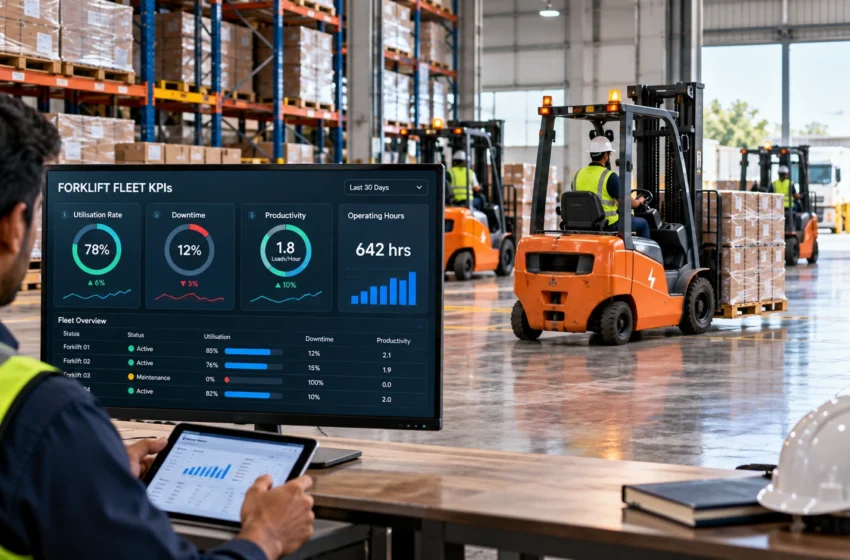
Forklift utilisation measures how effectively a forklift fleet is being used against the time and capacity available. To evaluate fleet performance, businesses should track utilisation alongside downtime, productivity, maintenance frequency, availability and operating costs.
A forklift that spends too much time idle may indicate excess fleet capacity, while a fleet operating continuously with frequent breakdowns may indicate insufficient capacity or maintenance issues. Tracking the right KPIs helps warehouses, manufacturing facilities, logistics operations and other businesses make more informed decisions about equipment, maintenance and rental requirements.
Key Takeaways
- Forklift utilisation should be measured alongside downtime and productivity.
- High utilisation is not automatically a sign of an efficient fleet.
- Downtime should be categorised to identify recurring equipment and operational issues.
- Maintenance data can help identify forklifts that require closer attention or replacement.
- Forklift rental services can provide additional capacity when demand exceeds available fleet capacity.
Why Should Businesses Measure Forklift Fleet Performance?
Forklifts are often essential to warehouse, manufacturing and logistics operations, but simply counting the number of machines does not reveal whether the fleet is being used effectively.
One forklift may be heavily utilised while another remains idle for long periods. Similarly, a machine may show high operating hours but contribute less productivity because of frequent breakdowns, inefficient travel or unsuitable deployment.
Fleet KPIs provide a structured way to identify these patterns.
What Is Forklift Utilisation?
Forklift utilisation refers to how much of the available operating time a forklift is actually being used for material-handling activities.
A basic utilisation calculation can be expressed as:
Forklift Utilisation = Actual Operating Time ÷ Available Operating Time × 100
For example, if a forklift is available for 8 operating hours and is actively engaged in handling work for 6 hours, its utilisation based on this simple measure would be 75%.
Businesses should define “operating time” consistently because different tracking systems may measure engine hours, travel time, lift activity or operator-assigned work differently.
Which KPIs Should You Track?
How much is each forklift being utilised?
Compare operating hours across the fleet rather than looking only at the overall average.
Large differences between forklifts may indicate uneven workload distribution or equipment that is not being deployed effectively.
How much downtime is occurring?
Track both planned and unplanned downtime.
Useful downtime categories can include:
- Preventive maintenance
- Repairs
- Breakdown waiting time
- Parts availability
- Operator-related delays
- Charging or refuelling
- Other operational delays
Categorising downtime makes recurring problems easier to identify.
How productive is the fleet?
Productivity should connect equipment activity with the work being completed.
Depending on the operation, businesses may track:
- Loads moved
- Pallets handled
- Trips completed
- Material moved per operating hour
- Loading and unloading cycles
The most useful productivity measure depends on the actual workflow.
MHE Selection Table
| Operational Requirement | KPI to Monitor | Equipment Consideration |
|---|---|---|
| High-volume pallet movement | Loads or pallets per operating hour | Suitable forklift capacity and availability |
| Receiving and unloading | Handling cycles and waiting time | Forklift availability at receiving areas |
| Warehouse put-away | Put-away cycles and travel time | Equipment suited to warehouse layout |
| Manufacturing material movement | Trips or loads per shift | Equipment matched to production workflow |
| Temporary demand increase | Utilisation and equipment availability | Forklift rental services |
| Frequent equipment downtime | Downtime and repair frequency | Maintenance or replacement assessment |
KPIs should always be interpreted alongside the operating environment and workload.
What Does High Forklift Utilisation Actually Tell You?
High utilisation can indicate that equipment is in strong demand, but it does not automatically mean the fleet is operating efficiently.
If forklifts are consistently busy and operators frequently wait for equipment, the business may have insufficient fleet capacity.
On the other hand, if high utilisation is accompanied by frequent breakdowns, rising maintenance requirements or reduced productivity, the fleet may be under excessive operational pressure.
The objective is to find an appropriate balance between utilisation, availability and productivity.
How Can Downtime Be Reduced?
Track the reason, not just the duration
Recording that a forklift was unavailable for four hours is useful, but identifying why it was unavailable provides more actionable information.
Look for recurring patterns involving:
- Specific equipment
- Particular components
- Operating conditions
- Maintenance intervals
- Repeated breakdown types
Use preventive maintenance
Planned maintenance can help businesses identify equipment issues before they develop into larger operational disruptions.
Forklift maintenance services can support businesses that require structured maintenance and technical assistance for their material-handling fleet.
How Can Businesses Improve Fleet Productivity?
A practical KPI review can follow a simple process.
Step 1: Establish a baseline — Record utilisation, downtime, operating hours and relevant productivity measures for each forklift.
Step 2: Compare forklifts — Identify machines with unusually high or low utilisation, downtime or maintenance requirements.
Step 3: Identify bottlenecks — Check whether operators are waiting for equipment, whether forklifts are travelling excessive distances or whether receiving and storage areas are creating delays.
Step 4: Review equipment suitability — Determine whether each forklift is appropriate for its assigned load, environment and workload.
Step 5: Review maintenance data — Look for recurring repairs, increasing downtime or equipment that requires disproportionate maintenance attention.
Step 6: Adjust the fleet — Depending on the findings, businesses may redistribute equipment, change maintenance schedules, replace unsuitable equipment or consider additional rental capacity.
When Can Forklift Rental Services Help?
Fleet KPIs can also indicate when additional equipment may be required.
Forklift rental services can be considered when:
- Existing forklifts are consistently highly utilised
- Seasonal demand temporarily increases workload
- A forklift is undergoing extended maintenance
- A new facility is being established
- A project creates temporary material-handling requirements
- Businesses need additional equipment without immediately purchasing another forklift
Rental should be evaluated against actual utilisation and expected duration rather than being used simply to increase the number of forklifts.
Cost Considerations
Fleet performance should ultimately be connected to cost.
Consider:
- Rental or ownership costs
- Fuel or electricity consumption
- Preventive maintenance
- Repairs and spare parts
- Downtime
- Operator costs
- Attachments
- Equipment utilisation
- Productivity
- Replacement requirements
A forklift with a low rental or acquisition cost may not necessarily be economical if it experiences frequent downtime or is unsuitable for the application.
Similarly, an underutilised forklift can represent unnecessary fleet expenditure.
India-Specific Considerations
Indian warehouses, manufacturing plants, automotive facilities, logistics operations and large retail distribution centres can have significantly different material-flow requirements.
Shift patterns, seasonal demand, facility layouts and changing production requirements can all affect forklift utilisation.
Businesses should therefore establish KPIs according to their specific operating environment instead of relying on a generic fleet benchmark.
Common Mistakes Businesses Should Avoid
- Measuring utilisation without measuring downtime
- Treating high utilisation as automatically positive
- Using fleet-wide averages that hide individual forklift performance
- Failing to record downtime reasons
- Ignoring maintenance trends
- Comparing forklifts operating in completely different applications
- Tracking operating hours without productivity measures
- Keeping underutilised equipment without reviewing the requirement
- Adding forklifts without identifying the actual bottleneck
- Delaying maintenance until a breakdown occurs
Industry Insight
At Mazda Movers, we view fleet performance as a combination of equipment availability, utilisation and suitability.
A forklift that is constantly operating is not necessarily performing optimally if it is also experiencing frequent downtime. Similarly, equipment that has very low utilisation may indicate that the fleet is larger than the operation currently requires.
Looking at these measures together gives businesses a clearer picture of where equipment is being used effectively and where changes in deployment, maintenance or rental capacity may be appropriate.
How to Choose a Forklift and MHE Partner
When evaluating an MHE partner, businesses should consider:
- Understanding of the application
- Ability to support different forklift requirements
- Preventive maintenance capabilities
- Breakdown and service support
- Rental options
- Availability of suitable equipment
- Spare parts and maintenance support
- Flexibility as operational requirements change
- Clear commercial and service terms
A suitable partner should be able to support both equipment requirements and ongoing fleet maintenance.
Why Mazda Movers?
Mazda Movers provides material-handling solutions including forklift rental services, MHE solutions and forklift maintenance services.
For businesses monitoring fleet performance, these services can support additional capacity, equipment replacement, maintenance requirements and ongoing material-handling operations.
Key Takeaway
Effective forklift utilisation is not about keeping every machine busy at all times. It is about balancing equipment use, availability, productivity, maintenance and operating cost.
Track utilisation alongside downtime and productivity to understand whether your fleet has the right equipment, capacity and maintenance approach for the operation. If your fleet is experiencing capacity constraints or recurring downtime, an MHE partner can help assess the available equipment and support options.
FAQs
Q1. What is forklift utilisation?
A. Forklift utilisation measures how much of a forklift’s available operating time is spent performing material-handling work.
Q2. How do you calculate forklift utilisation?
A. A basic formula is: Actual Operating Time ÷ Available Operating Time × 100. Businesses should use a consistent definition of operating time when comparing equipment.
Q3. What forklift KPIs should a warehouse track?
A. Common KPIs include utilisation, downtime, equipment availability, operating hours, maintenance frequency and productivity measures such as loads or pallets handled per operating hour.
Q4. How can forklift downtime be reduced?
A. Track the causes of downtime, follow preventive maintenance schedules and address recurring equipment issues before they result in larger operational disruptions.
Q5. When should a business consider forklift rental?
A. Forklift rental services can be useful when equipment demand temporarily increases, existing forklifts are unavailable for maintenance, or a business needs additional capacity without immediately purchasing another machine.