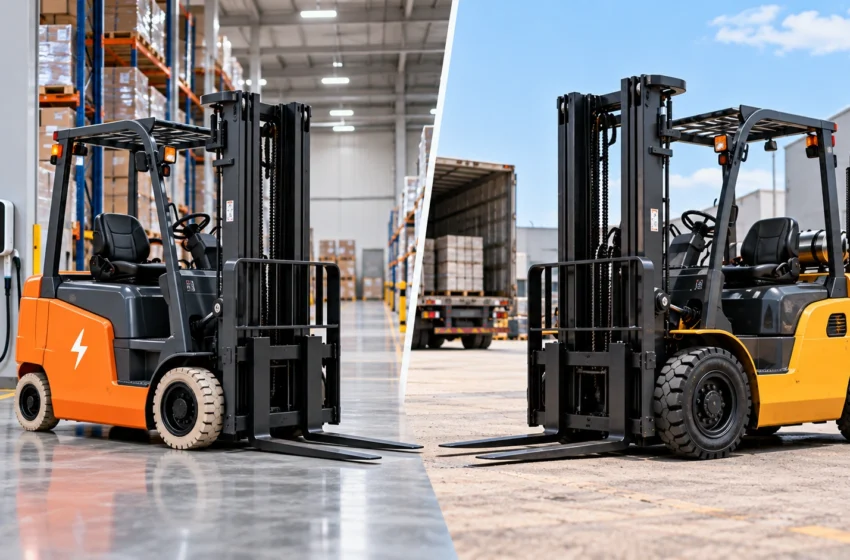
Quick Answer
The choice between an electric vs diesel forklift depends on the working environment, load-handling requirements, operating hours, infrastructure, ventilation, maintenance needs and overall cost of operation. Electric forklifts are often considered for indoor warehouses and facilities where lower noise and zero tailpipe emissions are important, while diesel forklifts can be suitable for outdoor and demanding applications where continuous operation and fuel availability are practical considerations.
There is no single option that suits every business. The right forklift should be selected by assessing the actual application, including the load, operating surface, travel distance, working environment and expected utilisation.
Key Takeaways
- Electric forklifts can be well suited to indoor warehouses and controlled operating environments.
- Diesel forklifts can be useful for outdoor and demanding material-handling applications.
- Purchase or rental price alone does not determine the better option.
- Energy or fuel, maintenance, downtime, charging or refuelling and utilisation should be evaluated together.
- Businesses can consider forklift rental services when they need to test equipment suitability or manage temporary requirements.
What Is the Difference Between Electric and Diesel Forklifts?
The main difference is the power source.
Electric forklifts use battery power and are commonly considered for indoor material-handling applications. Diesel forklifts use an internal-combustion engine and can be suitable for outdoor operations and applications where the operating environment and duty cycle support their use.
The correct choice depends on how and where the forklift will be used.
Which Forklift Is Better for Indoor Warehousing?
Where do electric forklifts have an advantage?
Electric forklifts can be particularly suitable for indoor facilities where noise, ventilation and operating conditions are important considerations.
They can be considered for:
- Warehouses
- Distribution centres
- Large retail storage facilities
- Indoor manufacturing areas
- Facilities where controlled operating conditions are available
Battery charging requirements and available charging infrastructure should be assessed before choosing an electric forklift.
When might diesel be less suitable indoors?
Diesel forklifts produce exhaust emissions during operation, making the operating environment an important consideration. Indoor facilities need to assess ventilation and applicable workplace requirements before using internal-combustion equipment.
Are Diesel Forklifts Better for Outdoor Operations?
Diesel forklifts can be suitable for applications involving outdoor material movement, loading and unloading, construction-related handling and other environments where the operating conditions are appropriate.
They may be considered when businesses require:
- Outdoor operation
- Longer operating cycles
- Use across demanding work areas
- Refuelling rather than battery charging
- Equipment suited to the site and application
The actual surface, load and working conditions should still be assessed before selecting the equipment.
Electric vs Diesel Forklift: Comparison Table
| Factor | Electric Forklift | Diesel Forklift |
|---|---|---|
| Typical environment | Indoor and controlled environments | Outdoor and suitable industrial environments |
| Power source | Battery | Diesel fuel |
| Tailpipe emissions | None during operation | Produced during operation |
| Noise | Generally lower operating noise | Generally higher operating noise |
| Charging/refuelling | Requires charging infrastructure and suitable charging time | Requires fuel availability |
| Maintenance | Requires battery and electrical system maintenance | Requires engine and associated system maintenance |
| Operating environment | Suitable where emissions and noise are important considerations | Suitable where outdoor operation is appropriate |
| Application | Warehousing, retail and selected manufacturing | Outdoor, industrial and demanding applications |
This comparison is general. Individual forklift models can differ in design, performance and operating requirements.
What Operational Factors Should You Consider?
Operating hours
A forklift used occasionally has different requirements from equipment operating throughout a shift or across multiple shifts.
For electric forklifts, charging strategy and battery availability become particularly important as utilisation increases.
Load and lift requirements
The forklift must be suitable for the weight and dimensions of the load as well as the required lift height.
Businesses should not select equipment based on power source alone.
Working surface
Warehouse floors, loading areas, yards and construction environments can present very different operating conditions.
Surface quality, gradients, obstacles and available manoeuvring space should be assessed before equipment selection.
Ventilation and emissions
Indoor operations should consider ventilation and the implications of operating combustion-powered equipment in enclosed areas.
How Should You Choose Between Electric and Diesel?
Step 1: Define the application — Identify what materials will be handled, how frequently they will be moved and where the forklift will operate.
Step 2: Assess the environment — Determine whether the work is indoors, outdoors or a combination of both.
Step 3: Review utilisation — Estimate operating hours, shifts and expected workload.
Step 4: Check infrastructure — For electric equipment, assess charging facilities, charging time and battery management requirements. For diesel equipment, consider fuel availability and storage arrangements where applicable.
Step 5: Compare operating costs — Review energy or fuel, maintenance, downtime, operators and other operating requirements.
Step 6: Evaluate the complete equipment configuration — Consider attachments, load requirements, working height and site conditions before making the final decision.
When Does Forklift Rental Make Sense?
Businesses do not always need to purchase a forklift immediately.
Forklift rental services can be considered when a company:
- Has a temporary increase in material-handling demand
- Needs replacement equipment
- Is setting up a new warehouse
- Has a short-term project
- Wants to evaluate a forklift type before a longer-term decision
- Requires additional handling capacity during peak periods
Businesses looking for a forklift on rent should provide the rental provider with clear information about the application, load and operating environment.
Cost Considerations
The cost comparison between electric and diesel forklifts should extend beyond the initial purchase or rental rate.
Consider:
- Equipment acquisition or rental cost
- Electricity or diesel consumption
- Battery charging requirements
- Fuel management
- Preventive maintenance
- Repairs and spare parts
- Downtime
- Operator requirements
- Attachments
- Expected utilisation
- Infrastructure requirements
For electric forklifts, battery condition and charging practices form part of the operational equation. For diesel forklifts, fuel consumption and engine-related maintenance need to be considered.
A lower initial cost does not automatically mean a lower total operating cost.
India-Specific Considerations
Indian businesses operate forklifts across warehouses, manufacturing plants, automotive facilities, logistics hubs, retail distribution operations and outdoor industrial sites.
The diversity of these environments makes application-based selection important. An electric forklift may suit an indoor warehouse with suitable charging arrangements, while a diesel forklift may be more appropriate for an outdoor operation.
Businesses should also consider local infrastructure, operating schedules, maintenance support and the availability of suitable energy or fuel arrangements.
Common Mistakes to Avoid
- Choosing a forklift solely by purchase or rental price
- Selecting equipment based only on load capacity
- Ignoring the operating environment
- Underestimating utilisation
- Choosing electric equipment without assessing charging requirements
- Choosing diesel equipment without considering indoor operating conditions
- Ignoring maintenance and downtime
- Forgetting attachment requirements
- Not assessing the working surface
- Comparing equipment without considering total operating cost
Industry Insight
At Mazda Movers, we look at the application before recommending a material-handling solution.
When comparing electric and diesel forklifts, the important questions are where the equipment will operate, what it will handle, how frequently it will be used and what support the operation requires.
The power source is only one part of the decision. A forklift that suits the environment and workload can be more useful than simply choosing the option with the lowest quoted cost.
How to Choose an MHE Partner
Before selecting a forklift provider, businesses should check:
- Understanding of the application
- Availability of electric and diesel options where appropriate
- Equipment suitability
- Rental flexibility
- Maintenance and AMC support
- Breakdown service
- Availability of attachments
- Clarity of rental terms
- Equipment availability
- Ability to support changing requirements
A capable MHE partner should help compare equipment based on the actual operating conditions rather than recommending a solution solely on equipment category.
Why Mazda Movers?
Mazda Movers provides material-handling solutions including forklift rental, MHE solutions and AMC/maintenance support.
For businesses comparing electric and diesel equipment, these services can support temporary requirements, equipment replacement and ongoing material-handling operations.
Key Takeaway
Choosing between an electric and diesel forklift depends on the application, not simply on the power source. Consider the working environment, load, utilisation, infrastructure, maintenance, downtime and total operating cost before making a decision.
If you are evaluating a forklift on rent for your warehouse, manufacturing facility, logistics operation or other material-handling requirement, discussing the application with an experienced MHE provider can help identify suitable options.
FAQs
Q1. Is an electric forklift better than a diesel forklift?
A. Neither is universally better. Electric forklifts can suit many indoor applications, while diesel forklifts can be appropriate for suitable outdoor and demanding operations.
Q2. Which forklift is better for indoor warehouses?
A. Electric forklifts are often considered for indoor warehouses because they produce no tailpipe emissions during operation and generally operate more quietly. The facility’s charging and operating requirements should still be assessed.
Q3. Are diesel forklifts suitable for outdoor use?
A. Yes, diesel forklifts can be suitable for outdoor and industrial applications where the equipment and operating environment are appropriate.
Q4. Is an electric forklift cheaper to operate?
A. It depends on utilisation, electricity costs, charging requirements, maintenance and the specific equipment. Total operating costs should be compared rather than assuming one power source is always cheaper.
Q5. Can I get an electric or diesel forklift on rent?
A. Availability depends on the rental provider and equipment requirement. Businesses seeking forklift rental services should specify the application, load and operating environment when enquiring.