The distribution centre opened in March.
By June, the project lead was on the phone asking what went wrong. The DC was sized for double the throughput it was producing. The forklifts were the right number. The reach trucks were the right specification. And yet the operation was hitting eighty percent of the planned cycle time and producing seventy percent of the planned throughput. The audit traced it back to two decisions made in the equipment selection phase that had quietly compounded into the gap. Both were preventable with a tighter selection framework.
This post is that framework. Five steps. Three weeks of work. Applied before the racking is locked, it usually saves a year of throughput catch-up.
The Distribution Centre That Outgrew Its Equipment Before Launch
A distribution centre is a system. The MHE is the circulatory system. When the MHE selection is specified to the building rather than to the operation the building will house, the system underperforms from day one.
The selection failures we see repeat across DC projects:
- Equipment specified for the average shift, not the peak shift
- Fleet count sized to year one volume without modelling year three
- Energy infrastructure scaled to the equipment count instead of the duty cycle
- Operator skill assumed instead of measured against the equipment
- Maintenance support sized to the headcount, not the geography
Each of these is a selection decision that compounds. None show up as the cause when throughput is low six months in.
What “Selecting MHE” Actually Covers
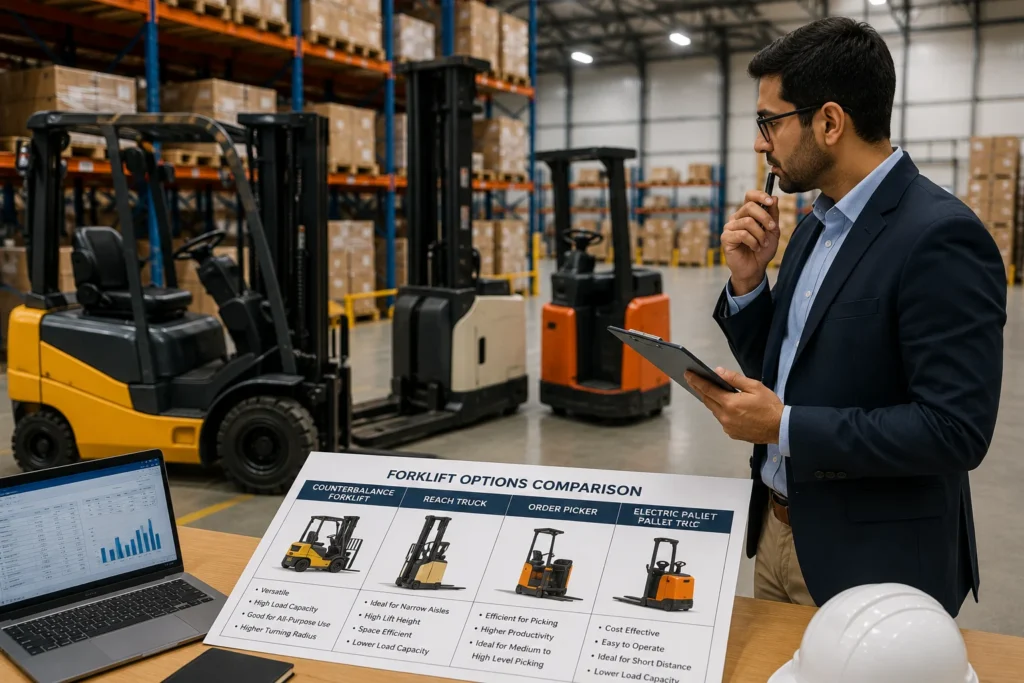
MHE selection is not equipment procurement. Equipment procurement is the last step. Selection is the engineering decision about which equipment families, in what mix, at what fleet count, will deliver the planned throughput at year one, year three, and year five volumes.
The selection decision drives:
- Aisle width specification, which drives racking density
- Charging infrastructure specification, which drives electrical loading
- Operator skill requirement, which drives recruitment and training
- Maintenance support requirement, which drives vendor selection
- Capital structure (own, lease, rent), which drives capex planning
Get the selection right, and procurement is straightforward. Get the selection wrong, and procurement cannot rescue it.
The Five-Step Selection Framework
This is the framework the Vile Parle desk uses for Indian DC builds across the past five years.
Step 1: Throughput Modelling at Year 1, 3, 5 Volumes
The first step is a quantitative throughput model. Not an estimate. A model.
The model needs:
- Peak hourly inbound pallets at year 1, 3, 5
- Peak hourly outbound pallets at year 1, 3, 5
- Peak hourly picks at the SKU velocity profile at year 1, 3, 5
- Concurrency assumption (how many activities happen in parallel)
- Equipment cycle time per activity type, from manufacturer specs validated against the operation’s terrain
Output: the equipment count, by family, required at each year. The fleet sized to year three is usually right for capex purposes; year one underspends, year five overspends.
Step 2: Storage System Compatibility Check
The selected equipment must work with the planned racking. The compatibility check:
- Aisle width minus equipment manoeuvre clearance
- Beam height versus equipment lift height
- Pallet position depth versus equipment reach
- Floor flatness specification (FF/FL numbers) versus equipment tolerance
- Storage system type (selective, drive-in, push-back, automated) versus equipment compatibility
A common failure: drive-in racking specified for storage density, then the equipment selected is a standard counterbalance that cannot work in drive-in lanes. Either the racking changes or the equipment changes. The earlier this is caught, the cheaper the change.
Step 3: Energy and Charging Infrastructure Match
For electric fleets (most modern DC builds), the energy infrastructure needs to scale to the duty cycle, not just the equipment count.
The math:
- Total energy demand per shift = fleet count × hours operating × kWh per hour
- Charging bay floor area = fleet count × bay area per unit + rotation buffer
- Electrical loading = peak simultaneous chargers × charger draw
- Ventilation = lead-acid hydrogen extraction rate or lithium thermal load
A common failure: charging infrastructure scoped to the equipment count without modelling the rotation schedule. Equipment sits uncharged during peak shifts.
Step 4: Operator Skill Level and Training Reality
The selected equipment must match the operator skill the operation can recruit, train, and retain.
The reality check:
- What is the operator labour market like in the DC’s geography?
- What equipment licences are commonly held?
- What is the realistic training timeline for new operators on each equipment type?
- What is the turnover rate and how does that shape ongoing training cost?
A DC in a tier-2 Indian city with no existing turret truck operator base cannot run a turret-truck-dependent fleet without a significant training and retention plan. A DC in Bhiwandi with an established reach truck operator pool can. The selection has to account for this.
Step 5: Maintenance Network Coverage by Geography
The selected equipment must be maintainable in the DC’s geography within the operation’s uptime target.
The check:
- Does the equipment vendor have service infrastructure within four hours’ drive?
- What is the spare parts inventory location and lead time?
- What is the vendor’s typical mean-time-to-repair on the selected equipment?
- Is there a vendor-agnostic service partner who can cover gaps?
A DC built in an emerging logistics corridor without vendor coverage will run at lower uptime than the same DC built next to a major service centre. The selection should reflect this reality.
The Equipment Mix by DC Type
Different DC types call for different equipment mixes. Some directional starting points:
| DC type | Typical fleet mix |
| FMCG mother warehouse | Reach trucks + counterbalance + order pickers + powered pallet trucks |
| E-commerce fulfilment | Order pickers + reach trucks + powered pallet trucks + (selectively) AGVs/AMRs |
| Cold chain DC | Cold-rated reach trucks + cold-rated counterbalance + insulated cabs where applicable |
| Pharma DC | Reach trucks + order pickers + clean-design equipment + clean-area operator protocols |
| Heavy industrial DC | Heavy counterbalance + side loaders + container handlers + sometimes reach stackers |
The fleet mix is directional. The actual specification needs the throughput model, the storage system, and the operator reality from Steps 1, 2, 4.
Five Common Selection Mistakes
From the DC builds we have audited at the Vile Parle desk:
- Sizing the fleet to average shift, not peak shift. The equipment works at average and queues at peak.
- Skipping the year-three volume model. The fleet that works at launch is undersized by year two.
- Assuming charging infrastructure scales linearly. It doesn’t. Rotation, simultaneity, and ventilation all need modelling.
- Picking equipment by manufacturer reputation rather than service network reality. The best equipment with the worst local service network underperforms in a DC build.
- Treating MHE selection as a procurement task instead of an engineering task. Procurement happens after selection, not instead of it.
Each is preventable in the five-step framework. None are cheap to fix after go-live.
The Vendor Evaluation Matrix
When the framework has produced the equipment specification, the vendor evaluation needs the same discipline. Five criteria:
- Equipment specification match (does the vendor have the specified model in stock or buildable within timeline)
- Service network coverage in the DC’s geography
- Uptime guarantee and penalty terms
- Training capability for the operator pool
- Capex versus lease versus rent commercial options
A vendor scoring well on all five is the right vendor. A vendor scoring well on price alone often is not.
When the Selection Should Pause the Build
Three signals from the selection framework that should pause the DC build before the racking is finalised:
- Throughput model output requires a fleet count that the building cannot physically accommodate at the planned aisle width
- Storage system compatibility check requires racking changes that affect the storage density commitment
- Charging infrastructure scaling requires electrical loading the building’s electrical design cannot deliver
Any one of these is a build-versus-design conflict that costs ten to a hundred times more after go-live than before. Pausing the build for two to four weeks to reconcile is almost always the right call.
Final Thoughts
Material handling equipment selection is one of the highest-leverage engineering decisions in a distribution centre build. The selection drives storage, energy, labour, and maintenance for the operation’s life. The framework above gives the project team a structured way to make the selection visible and defensible before procurement begins.
The DCs that follow this framework usually launch on plan and stay on plan. The DCs that compress selection into a procurement exercise often spend year two and year three rebuilding what should have been right at year one.
For Indian logistics teams designing a new distribution centre, the Vile Parle desk runs the five-step MHE selection framework as a structured engagement.
Request an MHE selection engagement from Mazda Movers — Vile Parle East, Mumbai.
→ Talk to the Mazda Movers Material Handling Team
Also, follow us on Instagram, Facebook and LinkedIn for insights on fleet modernization, automation trends, and advanced logistics strategies.