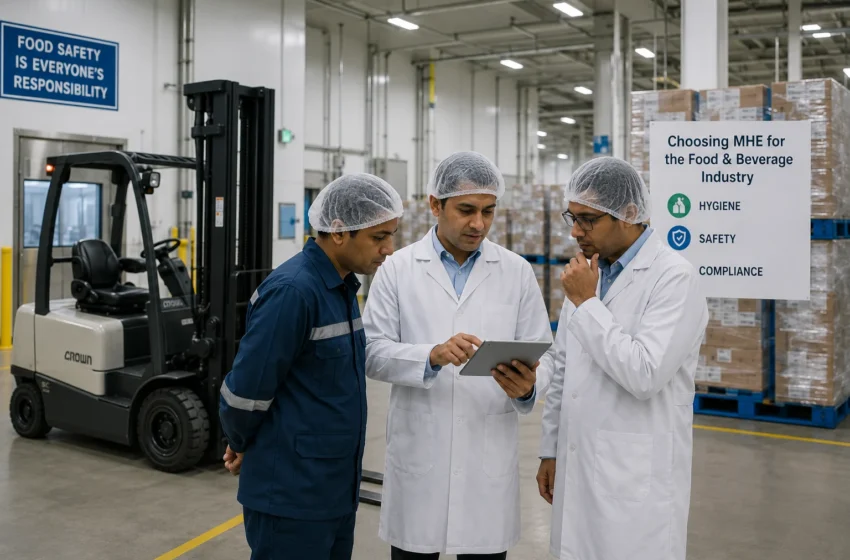
The compliance audit happened on a Tuesday.
By Friday, six forklifts had been pulled from the F&B warehouse floor. The auditor’s note was specific: standard industrial finishes, oil leakage points near food contact zones, no documented wash-down protocol, no FSSAI-aligned operator hygiene training. The equipment was operationally fine. It did not meet compliance requirements. The plant had four days to source replacements or shut down outbound dispatch. We spent that weekend at the Vile Parle desk sourcing compliant fleet for an emergency lease.
This is the post for the F&B operations head who would rather not have that weekend. The MHE selection for F&B is its own discipline, and the standard industrial fleet does not meet the bar.
The Compliance Audit That Sent the Fleet Back to the Yard
F&B and FMCG operations carry compliance requirements that general industrial operations do not. The MHE has to satisfy:
- Hygiene standards for food contact and food-adjacent zones
- Safety standards for cold storage, wet floors, and high pedestrian-equipment mix
- Regulatory standards from FSSAI, BIS, and where applicable, export market authorities
A forklift that is fine in an automotive warehouse can be non-compliant in a dairy warehouse for reasons that are not visible to the operator until the auditor surfaces them. The selection conversation has to happen before the equipment lands on the floor.
Why Food & Beverage MHE Is a Different Category
The differences are structural, not cosmetic. F&B MHE typically needs:
- Wash-down capability. Equipment that gets sanitised daily needs sealed components, stainless or coated surfaces, and drainage points that do not trap water.
- No-leak hydraulics. Hydraulic systems with food-grade or biodegradable fluids, and zero-leak fittings near food contact zones.
- Cold-rated components. For cold storage and frozen environments, equipment with cold-rated batteries, hydraulics, tyres, and electronics.
- Pedestrian-safe operation. Higher pedestrian density in F&B warehouses calls for blue-spot lights, proximity sensors, speed limiters, and equipment-pedestrian alarms.
- Documented hygiene protocol. Operator handover procedures, wash-down logs, and contamination response procedures aligned to the customer’s audit framework.
Standard industrial fleet usually has none of these built in. Adding them after equipment is on the floor is expensive and often partial.
The Three Regulatory Frameworks That Apply
Three regulatory layers govern F&B MHE selection in Indian operations:
- FSSAI (Food Safety and Standards Authority of India) — sets the licensing and audit framework for food businesses, including warehouse and distribution operations. Equipment in food handling zones is part of the audit scope.
- BIS (Bureau of Indian Standards) — equipment certification standards apply to all industrial equipment, with category-specific extensions for food sector use.
- Customer audit frameworks — many large F&B customers (multinational FMCG, large retail buyers, export buyers) impose their own audit frameworks (BRCGS, IFS, SQF, AIB) on their suppliers and warehouse partners.
A serious F&B warehouse meets all three. The equipment specification has to be written to the highest of the three.
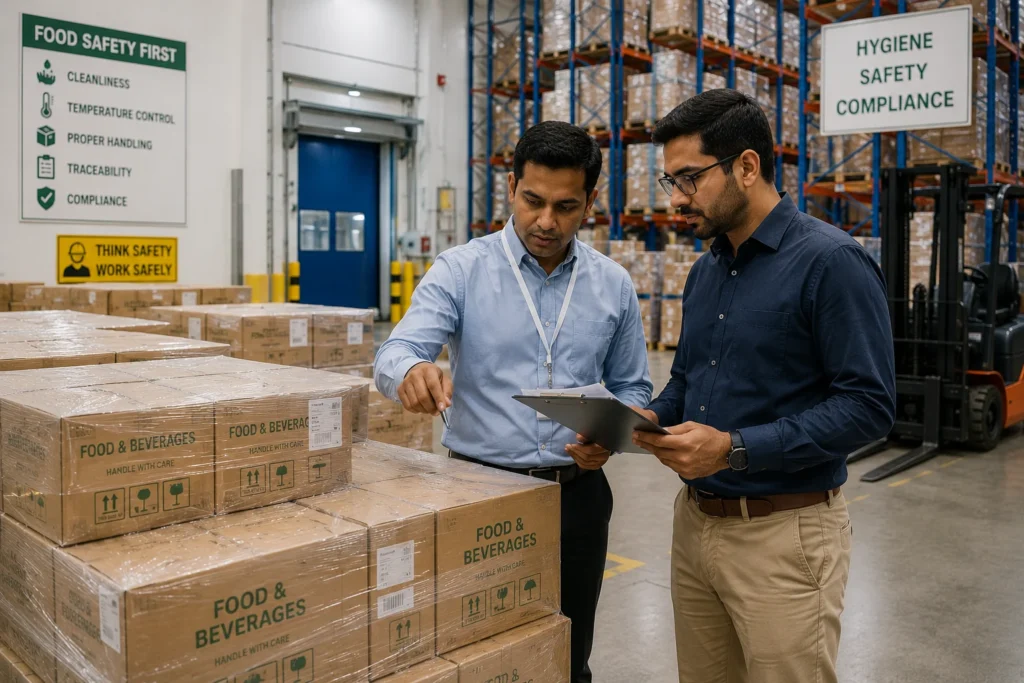
Hygiene Requirements: Wash-Down, Stainless, Sealed Components
The hygiene specification for F&B-zone equipment typically includes:
- Stainless steel or food-grade-coated mast and overhead guard surfaces in direct food contact zones
- Sealed electrical and control housings rated to IP65 or better for wash-down environments
- Drainage points and slopes that prevent water and food residue accumulation
- Removable or easily cleanable operator seat covers and grip surfaces
- Documented wash-down protocol including frequency, agents, drying, and inspection
Equipment that does not meet these typically gets relegated to non-food-contact zones (dispatch staging, dock work) where the audit standard is looser. The mistake is using non-compliant equipment in food contact zones because it is what’s available.
Safety Requirements: Cold Storage, Wet Floor, Pedestrian Mix
F&B safety differs from general warehouse safety in three dimensions:
- Cold storage operation — operators in cold environments need equipment with enclosed heated cabs, cold-rated batteries with extended discharge life at low temperature, and cold-tolerant hydraulic fluids.
- Wet floor operation — F&B floors are wet more often than industrial floors. Equipment needs anti-slip tyres, water-resistant electrical, and brake systems rated for wet-floor stopping distances.
- High pedestrian density — F&B operations typically have more pedestrian foot traffic per square metre than industrial warehouses. Equipment needs proximity warning systems, blue-spot lights, speed governors, and clear lane segregation.
The cumulative safety specification often pushes F&B fleet selection to specific manufacturer models, not the cheapest equivalent.
Compliance Requirements: FSSAI, BIS, Equipment Certification
The compliance documentation for F&B fleet typically includes:
- FSSAI license alignment of the warehouse operation
- BIS certification of the equipment itself
- Equipment-specific food-contact compliance certificates from the manufacturer
- Wash-down and sanitisation protocol documentation
- Operator training records aligned to the customer audit framework
- Maintenance logs that demonstrate compliance is sustained over equipment life
A serious F&B warehouse keeps all six documents current. The audit looks for them and the absence of any one can downgrade the audit score.
Equipment Types Suited to F&B
Some equipment families work better in F&B than others. Directional notes:
- Electric counterbalance forklifts with stainless or coated cosmetic surfaces, sealed electricals, IP65-rated controls — workhorse for most F&B operations
- Electric reach trucks with cold-rated battery options for chilled storage
- Powered pallet trucks with food-zone hygiene specification for receiving and outbound staging
- Order pickers for high-velocity case-pick operations, with operator cab hygiene specification
- Walkie stackers for low-volume zones where pedestrian density is high
Diesel equipment is generally avoided in food contact zones due to emissions and contamination risk. LPG equipment is acceptable in some operations but typically restricted to outdoor or well-ventilated yards.
The Five F&B-Specific Selection Criteria
When selecting MHE for F&B, five criteria sit above the general criteria:
- Wash-down design — IP rating, surface specification, drainage
- Cold operation capability — battery, fluids, components, operator cab
- Pedestrian safety equipment — proximity warning, blue-spot, speed governance
- Hygiene documentation — wash-down protocol, certification chain
- Audit-readiness — service records, training records, traceability
Equipment scoring well on all five is the right fleet for F&B. Equipment scoring well on general industrial criteria alone usually fails one or two of these and produces compliance exposure.
Five Mistakes F&B Operators Make on MHE Procurement
From the F&B fleet specifications we have run at the Vile Parle desk:
- Procuring on rate without verifying IP rating and hygiene specification. The standard fleet is cheaper; the hygiene retrofit is impossible.
- Treating cold storage equipment as standard equipment. Battery life and component reliability collapse without cold rating.
- Underestimating pedestrian density risk. Without proximity warning systems and lane discipline, the incident rate rises with throughput.
- Skipping the customer audit framework conversation. The customer’s audit framework dictates what equipment passes; the warehouse should know it before procurement.
- Not building the documentation chain from day one. Reconstructing wash-down logs at audit time is impossible; the protocol has to start with the equipment.
Each is preventable in the specification phase. None is cheap to fix after compliance audit findings.
When to Specify Hygienic Design from the Start
Three conditions where the F&B-specific specification is non-negotiable:
- Equipment will operate in any direct food contact zone (storage of unpackaged or primary-packaged food)
- Customer audit framework requires it (BRCGS, IFS, SQF, AIB)
- Cold storage or wet-floor operating environment is part of the operation
Any one of these warrants the F&B specification from the start. Trying to retrofit later costs three to five times the upfront premium and rarely achieves full compliance.
The F&B MHE Specification Checklist
Before any F&B fleet procurement signature:
- IP rating verified for wash-down zones (IP65 minimum)
- Surface specification verified for food contact compliance
- Cold rating verified for cold storage zones (battery, fluids, components)
- Pedestrian safety equipment specified (proximity, blue-spot, speed governance)
- Hygiene documentation chain established (protocol, frequency, agents, logs)
- Customer audit framework requirements mapped to equipment specification
- FSSAI and BIS certification documents collected and filed
- Operator training programme aligned to audit framework
- Maintenance contract includes hygiene component coverage
- Service vendor has F&B sector experience and reference customers
Ten checks. Two weeks of work. The price of skipping is the audit-Tuesday story that opens this post.
Final Thoughts
F&B MHE is a specialist category. The selection cannot be made from a general industrial catalogue. The compliance framework is real, the audit consequences are real, and the customer relationship damage from a non-compliant fleet is real.
The F&B operations that build their fleet to the highest of the FSSAI, BIS, and customer audit standards from day one operate with audit confidence. The operations that try to retrofit usually carry compliance risk for the equipment’s full life.
For Indian F&B and FMCG warehouse operations specifying a new fleet or facing audit pressure on the current fleet, the Vile Parle desk runs an F&B MHE specification engagement.
Request an F&B MHE specification engagement from Mazda Movers — Vile Parle East, Mumbai.
→ Talk to the Mazda Movers Material Handling Team
Also, follow us on Instagram, Facebook and LinkedIn for insights on fleet modernization, automation trends, and advanced logistics strategies.